


When a loved one passes away in Florida, the last thing you want is a long, expensive court process. The good news: many Florida estates qualify for a faster, simpler alternative called Summary Administration, a streamlined probate process that can save your family significant time, money, and stress.
In this guide, a Florida probate attorney breaks down exactly what Summary Administration is, who qualifies, and what the process looks like from start to finish.
In this article:
- The Problem with Traditional Probate in Florida
- What Is Summary Administration?
- Who Qualifies for Summary Administration in Florida?
- The Summary Administration Process: Step by Step
- Key Benefits of Summary Administration
- DIY vs. Hiring a Florida Probate Attorney
- Frequently Asked Questions
The Problem with Traditional Probate in Florida
To appreciate why Summary Administration exists, it helps to understand what it replaces: Formal Administration.
Formal Administration is the standard, court-supervised probate process required for larger estates in Florida. It involves:
- Appointing a personal representative (executor) to manage the estate
- Formally notifying all known creditors
- Filing detailed inventories and accountings with the probate court
- Navigating ongoing court oversight throughout the process
The result? Formal Administration can take six to twelve months, sometimes longer, and legal fees can mount quickly. For families already dealing with grief, the added burden of a drawn-out court process can be overwhelming.
What Is Summary Administration?
Summary Administration is Florida’s simplified probate alternative, specifically designed for smaller or older estates. Think of Formal Administration as the scenic route and Summary Administration as the express lane.
Governed by Florida Statutes Chapter 735, Summary Administration cuts out many of the most time-consuming steps of formal probate. There is no court-appointed personal representative, court oversight is minimal, and assets can be transferred directly to beneficiaries much more quickly.
Who Qualifies for Summary Administration in Florida?
An estate qualifies for Summary Administration in Florida if it meets at least one of two conditions:
Condition 1: The Probate Estate Is Valued at $150,000 or Less (or $75,000 for Deaths Before July 1, 2026)
If the total value of the deceased person’s probate assets is $150,000 or less, the estate qualifies. This threshold applies to deaths occurring on or after July 1, 2026; for deaths before that date, the threshold is $75,000.
A critical distinction: not all assets count toward the applicable threshold described above. Florida law excludes certain exempt assets, most notably:
- The decedent’s primary residence (homestead property)
- Certain personal property protected under Florida’s exemption laws
This means an estate can be worth considerably more than the applicable threshold in total and still qualify for Summary Administration—as long as the non-exempt probate assets fall under that limit.
📌 Threshold Update: As of July 1, 2026, Florida’s Summary Administration threshold is $150,000 for deaths occurring on or after that date. For deaths before July 1, 2026, the $75,000 threshold applies.
Condition 2: The Decedent Has Been Deceased for More Than Two Years
Regardless of the estate’s value, Summary Administration is available if the person died more than two years ago. Under Florida law, most creditor claims expire after two years, which dramatically simplifies the process of settling the estate.
The Summary Administration Process: Step by Step
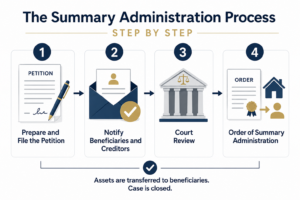
Once you’ve confirmed the estate qualifies, the process moves relatively quickly:
Step 1: Prepare and File the Petition
A “Petition for Summary Administration” is filed with the appropriate Florida probate court. This document identifies the decedent’s assets, lists who the beneficiaries are, and proposes a plan for distributing those assets.
Step 2: Notify Beneficiaries and Creditors
All beneficiaries named in the petition must be notified. Any known creditors must also be properly served. This step is important—errors here can invalidate the entire petition.
Step 3: Court Review
The judge reviews the petition to confirm the estate qualifies and that all legal requirements have been met.
Step 4: Order of Summary Administration
Once approved, the court issues an “Order of Summary Administration.” This is the legally binding document that authorizes the direct transfer of assets to the beneficiaries. The case is then closed.
Key Benefits of Summary Administration
For qualifying estates, the advantages over Formal Administration are substantial:
- Faster Resolution: While formal probate can last a year or more, a well-prepared Summary Administration case can often be completed in just a few months.
- Lower Legal Costs: Fewer procedural requirements mean fewer attorney hours and court fees.
- No Personal Representative Required: The estate avoids the time and expense of formally appointing and bonding a personal representative.
- Minimal Court Oversight: The process is far less burdensome for families, with no ongoing court supervision of the estate administration.
- Direct Asset Transfer: Once the Order of Summary Administration is issued, assets transfer directly to beneficiaries—no waiting for a personal representative to wind things down.
DIY vs. Hiring a Florida Probate Attorney
Technically, Florida law does not require you to hire an attorney for Summary Administration. But in practice, attempting to handle it yourself carries real risk.
The petition must be filed precisely. Every beneficiary and known creditor must be properly notified. Asset valuations must be accurate. A single error, a missing signature, an incorrect asset description, improper service of notice, can result in the court rejecting the petition outright, forcing you to start over.
Working with an experienced Florida probate attorney means:
- The petition is prepared correctly the first time
- All notice requirements are satisfied
- Asset valuations are properly documented
- The process moves as quickly as the court allows
- You have a professional advocate if any complications arise
Given that Summary Administration is already designed to be a cost-efficient process, the added peace of mind that comes with professional guidance is well worth it.
Frequently Asked Questions About Summary Administration in Florida
Can I use Summary Administration if the estate has debts?
Yes. Known creditors must still be notified and their valid claims addressed. However, the process for handling creditors is still more streamlined than in Formal Administration. After two years from the date of death, most creditor claims are legally barred in Florida.
What assets are excluded from the summary administration value limit?
Homestead property (the decedent’s primary residence) and certain personal property protected by Florida’s exemption laws do not count toward the applicable threshold: $150,000 for deaths on or after July 1, 2026, or $75,000 for earlier deaths.
How long does Summary Administration take in Florida?
While timelines vary by county and case complexity, a properly prepared Summary Administration case can often be completed in 2 to 3 months, compared to a year or more for Formal Administration.
Does Summary Administration avoid all probate court involvement?
Not entirely – a judge must still approve the petition and issue the Order of Summary Administration. However, there is no ongoing court supervision, which is what makes it significantly faster and less expensive.
What happens after the Order of Summary Administration is issued?
Assets are transferred directly to the beneficiaries as outlined in the order. The probate case is then closed.
Ready to See If Your Estate Qualifies?
If you’re handling an estate in Florida and think Summary Administration may apply, don’t navigate the process alone. Our firm focuses on Florida probate, trust administration, and estate planning and is dedicated to making this process as smooth and cost-effective as possible.
Contact us today for a consultation. We’ll review your situation and help you determine the best path forward.