

Estate Planning Attorney in Fort Lauderdale & Plantation, FL | Wills, Trusts & Estate Planning
Hi, I’m Samantha. I’m the owner of SJF Law Group, and I am going to give you a quick overview of Estate Planning and the four main documents that you should have.
So the first one is called the healthcare surrogate designation, and we do this in combination with a living will as well. So this is where you are going to appoint somebody to be able to make medical decisions for you if you’re ever incapacitated. The living will part of it is the “pull the plug” document that most people are familiar with. That’s where you’re going to specify under what circumstances you would ever want to be removed from life support. So that’s medical decisions.
Then we’ve got a durable power of attorney. This is for financial decisions. So this document is applicable while you are alive. You would appoint somebody to be able to make financial decisions for you if you are incapacitated. So this person can pay your bills, they can talk to somebody on your behalf, buy and sell property, access your bank account, talk to your financial advisor—they can do just about anything under the sun financially related. So it’s everything other than medical decisions. It’s a very broad document, powerful document. You do have to be cautious with it, but it’s very, very important.
So the healthcare surrogate and the durable power of attorney together are what will help you stay out of a guardianship proceeding. If you are incapacitated and you don’t have these legal documents in place, then the only way somebody can help you is to go to court and become your court-appointed guardian. That’s a horrible process—you never want to be involved in that.
Okay, so next we have a will. That’s kind of like your basic document. A lot of people are very familiar with this, also known as last will and testament—not to confuse it with a living will, very different. So your last will and testament is a document that says who gets what and who’s in charge of administering your estate when you pass away. But a will only controls the probate process—that’s its main job. It does not keep your estate out of probate. It doesn’t put your estate into probate. It just says what happens if you die owning some sort of asset that must go through the probate process.
So probate is triggered by the assets that you own. I always say it’s like a title transferring process. If you die owning something and it doesn’t pass some other way, it must go through the probate process in order to get where it’s going. So if you have a will and something goes through probate, your will is going to dictate who’s in charge (the personal representative) and where do your assets go (your beneficiaries). So a will is important to have.
But then there is a trust. So typically we’re talking about a revocable trust. So revocable just means—just like it sounds—you can revoke it, you can modify it, you can make changes to it. It’s not permanent unless you die. An irrevocable trust is a really, really, really awesome tool to use. It helps us avoid the probate process. So any assets that you put into a revocable trust don’t have to go through probate—they will pass according to the terms of the trust.
And not only does it help avoid probate on its own, but it provides tons of protections to your beneficiaries. So let’s say you have minor kids. You leave your estate in a revocable trust for them—you’re going to avoid a guardianship for the minor kids. We never want anything going into a guardianship for your minor kids. It’s very time-consuming, it’s very expensive, it’s a pain in the butt. And then when they turn 18, the guardianship terminates because they’re not a minor anymore, and they get whatever assets are in there. So you certainly wouldn’t want to leave them a million-dollar life insurance policy and they get that at age 18.
If you put your assets into a revocable trust, you get to choose who’s in charge of it—that’s called the trustee. You get to choose at what age your kids get any control over it or when they get the money. So you can actually leave assets in trust for their lifetime, potentially, and let them at some age start participating in that trust as a co-trustee. And then at a little bit older age, you can let them take over as a sole trustee.
But those assets can stay in that trust. They have access to them, but the part that stays in the trust will be protected from creditors, from their spouses, or if they themselves are ever incapacitated and can’t function for themselves. The successor trustee would take over and manage those funds and pay their bills and make distributions for their benefit and their care. Or if they are disabled—if they’re receiving some sort of government benefits that are need-based—the trust can help ensure that they don’t lose those benefits.
Or in the unfortunate event that they actually pass away, the trust will specify where those assets go—maybe it’s to their children, your grandchildren, held in further trust.
So a revocable trust is a super important tool. You still need a will because they’re different, and a will controls probate. When we do a separate revocable trust, we do what’s called a pour-over will—meaning that if something goes to the probate process, it is going to pour over into the trust. So everything will end up in that trust one way or another.
So those are the four main documents: healthcare surrogate and living will, durable power of attorney, a last will and testament (or a will), and a revocable trust.
Hope you enjoyed this short video. Keep your eye out for some more.
Estate planning is the process of legally organizing your assets, personal wishes, and healthcare decisions so they are carried out according to your intentions during your lifetime and after your death. While many people think estate planning is only about creating a will or trust, it is a comprehensive strategy designed to protect you, your loved ones, and your legacy. Working with an experienced Fort Lauderdale or Plantation estate planning attorney ensures your plan complies with Florida law, reflects your unique circumstances, and evolves as your life changes.
A complete estate plan typically includes key legal documents such as a will, revocable trust, durable power of attorney, and healthcare directives. These tools work together to determine how your assets will be distributed, who will manage your finances if you become incapacitated, and who will make medical decisions on your behalf.
Estate planning also addresses critical family considerations. If you have minor children, it allows you to legally name guardians to care for them and designate individuals to manage any inheritance on their behalf. Without these protections in place, courts may make those decisions for you.
Beyond asset distribution, estate planning helps minimize probate delays, reduce potential estate taxes, protect beneficiaries, and avoid family disputes. It ensures your wishes are clearly documented and legally enforceable.
Importantly, estate planning is not just for the wealthy. Individuals and families of all income levels can benefit from having a plan in place. Whether you own a home, have retirement accounts, run a business, or simply want to ensure your healthcare preferences are honored, an estate plan provides clarity and peace of mind.
Working with an experienced Fort Lauderdale estate planning attorney ensures your plan complies with Florida law, reflects your unique circumstances, and evolves as your life changes.
Why Do I Need an Estate Plan?
An estate plan is essential to protecting your family, assets, and future. It ensures that your wishes are legally documented and carried out if you become incapacitated or pass away, giving you control over critical decisions that would otherwise be left to the courts.
Without an estate plan, Florida law determines what happens to your assets, who will manage your estate, and even who may care for your minor children. This can lead to unintended outcomes, delays, and unnecessary stress for your loved ones during an already difficult time.
A comprehensive estate plan helps you avoid many common risks, including probate complications, family disputes, and unnecessary expenses. It allows you to clearly outline how your assets should be distributed, designate trusted individuals to make financial and medical decisions on your behalf, and provide structured support for your beneficiaries.
Estate planning also plays a key role in reducing potential estate taxes, protecting assets, and maintaining privacy. Tools such as trusts, powers of attorney, and healthcare directives work together to create a seamless plan that functions both during your lifetime and after your passing.
For families with minor children, an estate plan is especially important. It allows you to name guardians, ensuring your children are cared for by the people you trust most, rather than leaving that decision to the court.
Ultimately, estate planning provides peace of mind. It removes uncertainty, minimizes legal hurdles, and ensures your legacy is preserved according to your intentions.
Want a simple way to get started? Download our free Estate Planning Checklist to see what your plan should include.
Ready to Protect Your Family and Assets?
Whether you need a simple will or comprehensive trust-based plan, our Fort Lauderdale estate planning attorneys are here to help. Schedule your free consultation today – with flat-fee pricing and no hourly surprises, getting started is easier than you think.
What does a Last Will & Testament Do?
A Last Will & Testament is a foundational estate planning document that outlines how your assets will be distributed after your death and who will be responsible for carrying out your wishes. It provides clear legal instructions to the Florida probate court regarding your property, your beneficiaries, and your personal representatives.
A will primarily controls assets that are subject to probate, meaning assets held solely in your name without a designated beneficiary or joint owner. These may include real estate, bank accounts, personal property, and other individually owned assets. Because of this, a will does not avoid probate; instead, it directs how your probate assets are handled through the court process.
In your will, you can name a personal representative (also known as an executor) to manage your estate, pay debts, and distribute assets according to your instructions. You can also specify who should receive specific property, helping reduce confusion and potential disputes among family members.
For parents of minor children, a will is especially important because it allows you to designate a legal guardian. Without a valid will, the court will decide who will care for your children, which may not align with your preferences.
While a will is an essential part of any estate plan, relying on a will alone may result in delays, additional costs, and public court proceedings due to probate. Many individuals use a will alongside other estate planning tools, such as trusts, to create a more comprehensive plan.
Working with an experienced estate planning attorney ensures your will is properly drafted, legally valid under Florida law, and aligned with your overall estate planning strategy.
What Happens if I Don’t Have a Will?
If you pass away without a valid Last Will & Testament in Florida, your estate will be distributed according to the state’s intestacy laws. These laws create a default inheritance structure based on your closest family relationships, but they do not take your personal wishes into account.
Under Florida intestacy law, your assets typically pass to your spouse and/or children. If you do not have a spouse or children, your estate may go to other relatives such as parents, siblings, or more distant family members. This rigid legal formula can lead to outcomes that may not align with your intentions, especially in cases involving blended families, unmarried partners, or unique family dynamics.
Dying without a will also means the court will appoint a personal representative to manage your estate. This may not be the person you would have chosen to handle your financial affairs. Additionally, if you have minor children, a judge will decide who becomes their legal guardian, potentially leading to uncertainty or disputes among family members.
Without clear legal instructions, your loved ones may face a longer and more complicated probate process, increased legal costs, and added stress during an already difficult time. Family disagreements are also more likely when your wishes are not formally documented.
Creating a will allows you to maintain control over these critical decisions. It ensures your assets are distributed according to your wishes, allows you to name a trusted personal representative, and gives you the ability to designate guardians for your children.
What is a Revocable Trust?
A revocable trust, also known as a living trust or inter vivos trust, is a powerful estate planning tool that allows you to manage your assets during your lifetime and seamlessly transfer them to your beneficiaries after your death without going through probate.
“Revocable” means you retain full control. You can create, modify, or revoke the trust at any time while you are alive and competent. In most cases, you serve as the initial trustee, maintaining complete authority over your assets, while naming a successor trustee to step in if you become incapacitated or pass away.
A revocable living trust, also called an inter vivos trust, is one of the most powerful tools we use to help Florida families avoid probate, protect assets, and plan for incapacity.
One of the primary benefits of a revocable trust is probate avoidance. Assets properly titled in the name of the trust pass directly to your beneficiaries, saving time, reducing court involvement, and maintaining privacy. This can be especially valuable in Florida, where probate can be time-consuming and public.
A revocable trust also provides continuity in the event of incapacity. If you are unable to manage your affairs, your successor trustee can step in immediately to handle financial matters without the need for court-appointed guardianship.
Additionally, revocable trusts allow you to set specific terms for how and when your beneficiaries receive their inheritance. This is particularly useful for protecting minor children, beneficiaries with special needs, or individuals who may need structured distributions over time.
While revocable trusts offer many advantages, it is important to understand that they do not provide creditor protection during your lifetime. However, they can include provisions that help protect beneficiaries after your death.
An experienced estate planning attorney can help determine whether a revocable trust is appropriate for your situation and ensure it is properly drafted and funded to achieve your goals under Florida law.
What is a Health Care Surrogate Designation?
A Health Care Surrogate Designation is a legal document that allows you to appoint a trusted person to make medical decisions on your behalf if you are unable to communicate or make those decisions yourself. In Florida, this document is a critical part of a comprehensive estate plan, ensuring your healthcare preferences are respected during times of incapacity.
Your designated health care surrogate has the authority to consult with doctors, access your medical records, and make informed decisions about your treatment, including surgeries, medications, and long-term care options. You can also name an alternate surrogate in case your primary choice is unavailable.
This document can be tailored to your preferences. For example, you may grant your surrogate immediate authority or specify that their decision-making power only begins if you are deemed incapacitated. You can also include guidance about your wishes regarding life-prolonging procedures, end-of-life care, and other important medical considerations.
Without a Health Care Surrogate Designation, your loved ones may need to seek court approval to make medical decisions for you, which can cause delays and added stress during critical moments.
By putting this document in place, you maintain control over your healthcare decisions and ensure that someone you trust is empowered to act in your best interests.
What is a Living Will?
A Living Will is a legal document that outlines your wishes regarding life-prolonging medical treatment if you become seriously ill or incapacitated and are unable to communicate your decisions. It provides clear instructions to doctors and loved ones about the type of care you do, or do not, want in specific medical situations.
In Florida, a living will typically applies in circumstances involving end-stage conditions, terminal illness, or a persistent vegetative state. It allows you to specify whether you want life-sustaining procedures such as mechanical ventilation, feeding tubes, or other artificial life support to be withheld or withdrawn.
A living will is often confused with a Do Not Resuscitate (DNR) order, but they serve different purposes. A DNR is a medical order that specifically addresses whether you want CPR in an emergency, while a living will provides broader guidance about ongoing life-prolonging treatments and end-of-life care.
This document works alongside a Health Care Surrogate Designation, helping ensure that both your chosen decision-maker and your medical providers understand and follow your preferences.
Without a living will, your family may be forced to make difficult medical decisions without knowing your wishes, which can lead to emotional stress and potential disagreements.
Creating a living will allows you to maintain control over your medical care, reduce uncertainty for your loved ones, and ensure your healthcare choices are honored.
What is a Durable Power of Attorney?
A Durable Power of Attorney is a legal document that allows you to appoint a trusted person, known as your agent or attorney-in-fact, to manage your financial and legal affairs if you become unable to do so yourself. It is a critical component of a comprehensive estate plan, particularly for incapacity planning.
“Durable” means the authority remains in effect even if you become mentally or physically incapacitated. This ensures there is no gap in decision-making during emergencies or long-term illness.
The powers granted under a durable power of attorney can be broad or limited, depending on your preferences. Typically, your agent may handle tasks such as paying bills, managing bank accounts, filing taxes, dealing with insurance companies, overseeing investments, and buying or selling property. This allows your financial life to continue running smoothly without court intervention.
Without a properly executed durable power of attorney in Florida, no one, not even your spouse, automatically has the legal authority to act on your behalf regarding financial matters. In such cases, your loved ones may be forced to seek a court-appointed guardianship, which can be time-consuming, expensive, and restrictive.
It is also important to understand that a durable power of attorney generally only applies to assets held in your individual name. Assets owned by a trust are managed by the trustee according to the terms of the trust, which is why coordinating your power of attorney with your overall estate plan is essential.
Creating a durable power of attorney gives you control over who will manage your affairs, helps avoid unnecessary court involvement, and ensures your financial matters are handled by someone you trust.
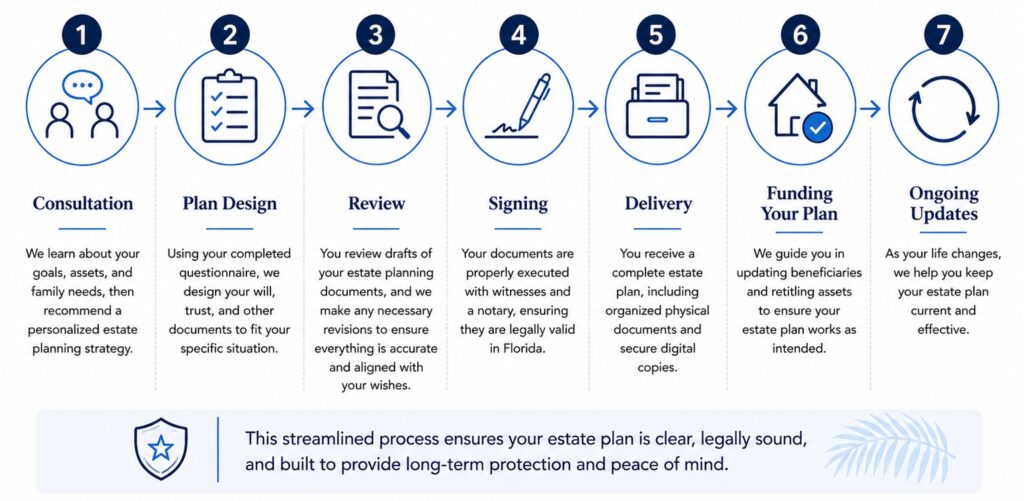
What is our Estate Planning Process?
Our estate planning process is designed to be simple, efficient, and tailored to your needs, ensuring your plan works under Florida law and protects your family.
What Makes SJF Law Group Different from Other Law Firms?
SJF Law Group delivers more than basic estate planning. We provide a comprehensive, long-term strategy to protect your assets, your family, and your legacy.
- Your plan is built by attorneys who do nothing else. 100% of our practice is dedicated to estate planning and probate, so every plan we create is designed specifically to work under Florida law, not adapted from a general practice template.
- Everything works together – not just the documents. We align your assets, beneficiary designations, and real estate with your estate plan so nothing falls through the cracks when it matters most.
- Your plan will actually work when your family needs it. From legal execution to trust funding and deed recordings, we make sure your plan is valid, enforceable, and ready, not just signed and filed away.
- Your plan doesn’t sit in a drawer. Clients receive organized estate planning binders, secure digital access, and complimentary annual reviews so your plan stays current as your life changes.
- You’re protected by attorneys with advanced credentials. You’re protected by an attorney with advanced credentials. Samantha holds an LL.M. in Taxation and is a licensed CPA, bringing specialized expertise in estate and tax planning that goes beyond standard legal training.
- We stand behind our work with a 100% money-back guarantee. If you’re not completely satisfied with your estate plan, we’ll refund your payment in full. No questions asked.
- You’ll always know exactly what you’re paying. Flat-fee pricing means no hourly billing, no surprise invoices, and no reason to hesitate picking up the phone with a question.
View our Peace-of-Mind Checklist to learn what to look for when choosing an estate planning attorney.
Who Needs an Estate Planning Attorney in Florida?
Our estate planning attorneys proudly serve individuals and families throughout the State of Florida, with an office in Plantation, FL, and a strong presence across Fort Lauderdale, Broward County, Miami-Dade County, and Palm Beach County. Whether you prefer in-person or virtual consultations, we make it easy to access experienced estate planning guidance no matter where you are located in Florida.
We work with a wide range of clients, including:
- Families with Minor Children – Helping parents name guardians, protect their children’s inheritance, and create plans that provide long-term financial security.
- Blended Families – Creating customized estate plans that balance the needs of spouses, children, and stepchildren while avoiding future conflicts.
- Young Professionals – Building foundational estate plans that protect assets, designate decision-makers, and plan ahead early.
- Retirees and Pre-Retirees – Assisting with asset protection, wealth transfer, and ensuring healthcare and financial decisions are handled according to their wishes.
- Business Owners – Developing strategies for business succession planning, asset protection, and minimizing disruptions to operations.
- High-Net-Worth Individuals and Families – Creating advanced estate and tax planning strategies designed to preserve wealth and reduce estate tax exposure.
Our Florida estate planning lawyers understand that every client’s situation is unique. Whether you need a simple will or a comprehensive trust-based plan, we tailor our services to meet your specific goals and ensure your estate plan aligns with Florida law.
If you are searching for an estate planning attorney in Fort Lauderdale, Broward, Miami-Dade, Palm Beach, or anywhere in Florida, our team is ready to help. Contact us today to schedule your free consultation and take the first step toward protecting your family, your assets, and your legacy.
Why Work With Our Estate Planning Attorneys?
Working with experienced estate planning attorneys ensures your wishes are clearly documented, legally enforceable, and designed to protect your loved ones. At SJF Law Group, we provide personalized estate planning services tailored to your unique goals, family dynamics, and financial situation.
As trusted estate planning and probate attorneys in Florida, we bring extensive experience helping individuals and families create comprehensive plans that work both during life and after death. Our team serves clients throughout Broward, Miami-Dade, and Palm Beach Counties, with a deep understanding of Florida-specific laws that impact your estate.
We prioritize convenience and accessibility by offering both in-person and virtual estate planning consultations, allowing you to get expert legal guidance from anywhere in Florida.
Our goal is simple: to provide clarity, confidence, and peace of mind through a well-structured estate plan that protects your legacy and the people who matter most. Call today to speak with an experienced Fort Lauderdale and Plantation estate planning attorney.
Our Estate Planning Attorneys


Ready to Schedule Your Estate Planning Consultation?
Call today to speak with an experienced Fort Lauderdale estate planning attorney for your free consultation. Our team responds promptly to every inquiry, making it easy to get the guidance you need to protect your family and your assets.