
Request a Complimentary Consultation
Start with your contact details and a brief message.
Submitting an inquiry does not establish an attorney-client relationship. Please do not include confidential information.
Serving Fort Lauderdale, Plantation & South Florida Families
Plan for the people you love.
Who would manage your finances if you couldn’t? Who would inherit your property? Our estate planning lawyers serve families in Fort Lauderdale, Plantation and across South Florida. We help you put those decisions in writing with wills, trusts, and healthcare and financial directives.
In-person and virtual consultations · Serving families throughout Florida
You want a plan for your children, your family and the decisions someone may need to make on your behalf.
A marriage, a move, a new child or another change may be a reason to revisit your existing documents.
You have questions about your home, accounts, business or beneficiaries—and how they fit into one plan.
Samantha Fitzgerald walks through the core estate planning documents and how they work together.
Prefer to read? Explore the details below ↓Samantha Fitzgerald · SJF Law Group
Hi, I'm Samantha. I'm the owner of SJF Law Group, and I am going to give you a quick overview of Estate Planning and the four main documents that you should have.
So the first one is called the healthcare surrogate designation, and we do this in combination with a living will as well. So this is where you are going to appoint somebody to be able to make medical decisions for you if you're ever incapacitated. The living will part of it is the “pull the plug” document that most people are familiar with. That's where you're going to specify under what circumstances you would ever want to be removed from life support. So that's medical decisions.
Then we've got a durable power of attorney. This is for financial decisions. So this document is applicable while you are alive. You would appoint somebody to be able to make financial decisions for you if you are incapacitated. So this person can pay your bills, they can talk to somebody on your behalf, buy and sell property, access your bank account, talk to your financial advisor—they can do just about anything under the sun financially related. So it's everything other than medical decisions. It's a very broad document, powerful document. You do have to be cautious with it, but it's very, very important.
So the healthcare surrogate and the durable power of attorney together are what will help you stay out of a guardianship proceeding. If you are incapacitated and you don't have these legal documents in place, then the only way somebody can help you is to go to court and become your court-appointed guardian. That's a horrible process—you never want to be involved in that.
Okay, so next we have a will. That's kind of like your basic document. A lot of people are very familiar with this, also known as last will and testament—not to confuse it with a living will, very different. So your last will and testament is a document that says who gets what and who's in charge of administering your estate when you pass away. But a will only controls the probate process—that's its main job. It does not keep your estate out of probate. It doesn't put your estate into probate. It just says what happens if you die owning some sort of asset that must go through the probate process.
So probate is triggered by the assets that you own. I always say it's like a title transferring process. If you die owning something and it doesn't pass some other way, it must go through the probate process in order to get where it's going. So if you have a will and something goes through probate, your will is going to dictate who's in charge (the personal representative) and where do your assets go (your beneficiaries). So a will is important to have.
But then there is a trust. So typically we're talking about a revocable trust. So revocable just means—just like it sounds—you can revoke it, you can modify it, you can make changes to it. It's not permanent unless you die. A revocable trust is a really, really, really awesome tool to use. It helps us avoid the probate process. So any assets that you put into a revocable trust don't have to go through probate—they will pass according to the terms of the trust.
And not only does it help avoid probate on its own, but it provides tons of protections to your beneficiaries. So let's say you have minor kids. You leave your estate in a revocable trust for them—you're going to avoid a guardianship for the minor kids. We never want anything going into a guardianship for your minor kids. It's very time-consuming, it's very expensive, it's a pain in the butt. And then when they turn 18, the guardianship terminates because they're not a minor anymore, and they get whatever assets are in there. So you certainly wouldn't want to leave them a million-dollar life insurance policy and they get that at age 18.
If you put your assets into a revocable trust, you get to choose who's in charge of it—that's called the trustee. You get to choose at what age your kids get any control over it or when they get the money. So you can actually leave assets in trust for their lifetime, potentially, and let them at some age start participating in that trust as a co-trustee. And then at a little bit older age, you can let them take over as a sole trustee.
But those assets can stay in that trust. They have access to them, but the part that stays in the trust will be protected from creditors, from their spouses, or if they themselves are ever incapacitated and can't function for themselves. The successor trustee would take over and manage those funds and pay their bills and make distributions for their benefit and their care. Or if they are disabled—if they're receiving some sort of government benefits that are need-based—the trust can help ensure that they don't lose those benefits.
Or in the unfortunate event that they actually pass away, the trust will specify where those assets go—maybe it's to their children, your grandchildren, held in further trust.
So a revocable trust is a super important tool. You still need a will because they're different, and a will controls probate. When we do a separate revocable trust, we do what's called a pour-over will—meaning that if something goes to the probate process, it is going to pour over into the trust. So everything will end up in that trust one way or another.
So those are the four main documents: healthcare surrogate and living will, durable power of attorney, a last will and testament (or a will), and a revocable trust.
Hope you enjoyed this short video. Keep your eye out for some more.
Our wills and trusts lawyers review how your documents, property ownership and beneficiary designations fit together.
Meet with our attorneys in Plantation or discuss your plan in a virtual consultation.
Our process includes document review, signing and guidance on funding your plan.
 Samantha J. FitzgeraldOwner & AttorneyRead profile →
 Marioly ChaconAssociate Attorney · Se habla españolRead profile →
Samantha Fitzgerald holds an LL.M. in Taxation and is a licensed CPA. Her profile explains her background in estate and tax planning.
Marioly Chacon works with many of our Spanish-speaking clients and can conduct your consultation in Spanish.
Ask us about flat-fee estate planning, what your fee includes and the terms of our estate plan guarantee. We will explain the scope before you decide to proceed.
Meet our estate planning attorneys and use the Peace-of-Mind Checklist to compare the services included in a proposed plan.
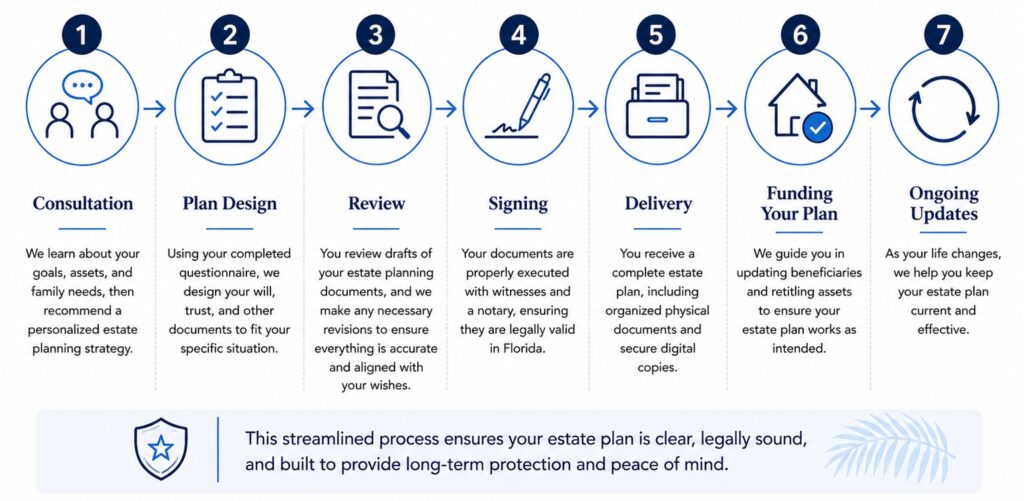
We begin with your goals, prepare the documents and help you put the plan into effect. Here is what the process involves.
We learn about your goals, assets, and family needs, then recommend a personalized estate planning strategy.
Using your completed questionnaire, we design your will, trust, and other documents to fit your specific situation.
You review drafts of your estate planning documents, and we make any necessary revisions to ensure everything is accurate and aligned with your wishes.
We arrange signing with the witnesses and notarization required for your documents.
You receive a complete estate plan, including organized physical documents and secure digital copies.
We guide you through the ownership and beneficiary changes needed to carry out your plan.
As your life changes, we help you keep your estate plan current and effective.
Estate planning records who should receive your property and who can act for you if you cannot manage your affairs. It also addresses the people who depend on you, including minor children and beneficiaries who need ongoing support.
Your plan may include a will, a revocable trust, a durable power of attorney and healthcare directives. The right combination depends on your family, assets and goals.
A plan lets you choose beneficiaries, nominate a guardian for minor children and authorize someone to handle financial or healthcare decisions. It can also address how an inheritance should be managed over time.
Without those instructions, state law and court procedures fill in many of the decisions. Assets and beneficiary designations also affect whether probate is needed. A will alone does not avoid probate.
Our Estate Planning Checklist can help you gather questions before a consultation.
Your Florida home needs its own review. Homestead rules can affect who may inherit it, how it is titled and whether a proposed transfer fits your family’s circumstances.
If you are survived by a spouse or a minor child, Florida law restricts how you can leave homestead property at death. A revocable trust does not remove those restrictions. We review the deed, your family situation and your estate planning documents together before recommending a transfer.
For complex assets and planning needs, explore our High Net Worth Estate Planning services. For adults starting out, see Estate Planning for Young Adults.
Learn about wills, trusts, and the documents that protect your property, family, and care decisions.
Use SJF’s guide to organize your questions.
Estate Planning Checklist →A will states who should receive your probate assets and nominates a personal representative to administer the estate. It can also nominate a guardian for minor children, subject to court approval.
A will does not control every asset. Accounts with beneficiary designations and property held with survivorship rights may pass separately. Your will should be coordinated with those arrangements.
If you die without a valid will, Florida’s intestacy laws determine who inherits your probate assets. The result depends on your surviving relatives and may differ from your wishes, particularly for unmarried partners or blended families.
The court also appoints a personal representative. A will allows you to state your preferred choice, subject to Florida’s qualification rules.
A revocable living trust, also called an inter vivos trust, holds assets under instructions you can generally change during your lifetime while competent. You can name a successor trustee to manage those assets after your death or if you become incapacitated.
Assets properly held in the trust can pass without probate. Funding matters: signing a trust does not automatically transfer your property into it. A revocable trust generally does not protect your assets from your own creditors during your lifetime.
This document names someone to make healthcare decisions under the authority you grant. You can name an alternate and specify when the authority begins.
If you cannot make decisions and have no available designated surrogate, Florida law provides a priority order for a healthcare proxy. Naming a surrogate records your own choice.
A living will records your wishes about life-prolonging treatment in the circumstances specified by Florida law, such as a terminal condition, end-stage condition or persistent vegetative state.
It works alongside your healthcare surrogate designation. It is different from a DNR order, which addresses resuscitation.
A durable power of attorney authorizes an agent to handle the financial or legal matters specified in the document. Under Florida law, it generally takes effect when signed; “durable” means it continues if you become incapacitated.
The agent’s powers depend on the document and applicable law. Trust assets are managed by the trustee, so the two documents should be coordinated.
Meet with our estate planning attorneys in Plantation or ask about a virtual consultation.
Share a brief overview of your goals and the best way to reach you.
(954) 580-3690Prefer a conversation? Call our office.
300 S. Pine Island Road, Suite 109
Plantation, FL 33324
Estate planning · Probate · Trust administration
Start with your contact details and a brief message.
Submitting an inquiry does not establish an attorney-client relationship. Please do not include confidential information.