

Key Takeaways
Understanding how probate works for large estates in Florida helps personal representatives avoid costly delays and personal liability. Here are the most important points:
- Estates with non-exempt assets over $75,000 require formal administration under Florida Statute §735.201. This means full court oversight, mandatory attorney representation, and strict procedural deadlines.
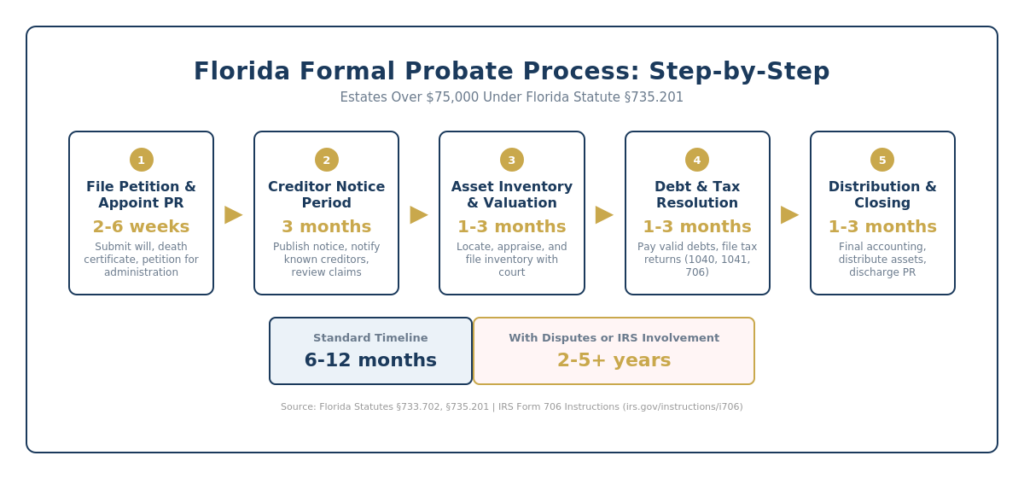
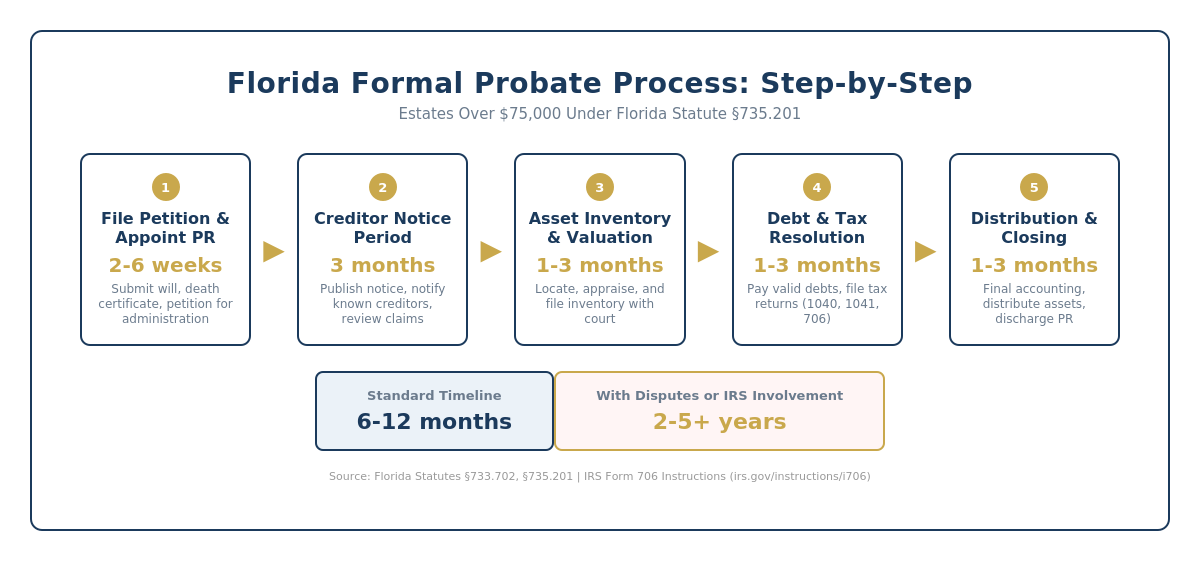
- Formal probate follows five stages: filing the petition, creditor notification, asset inventory, debt and tax resolution, and final distribution. The standard timeline runs 6 to 12 months. Disputes or IRS involvement extend the process to 2 to 5 years or longer.
- The personal representative (executor) carries legal responsibility for every step. Florida law requires this person to locate assets, notify creditors, pay debts, file taxes, and distribute property according to the will or state intestacy law.
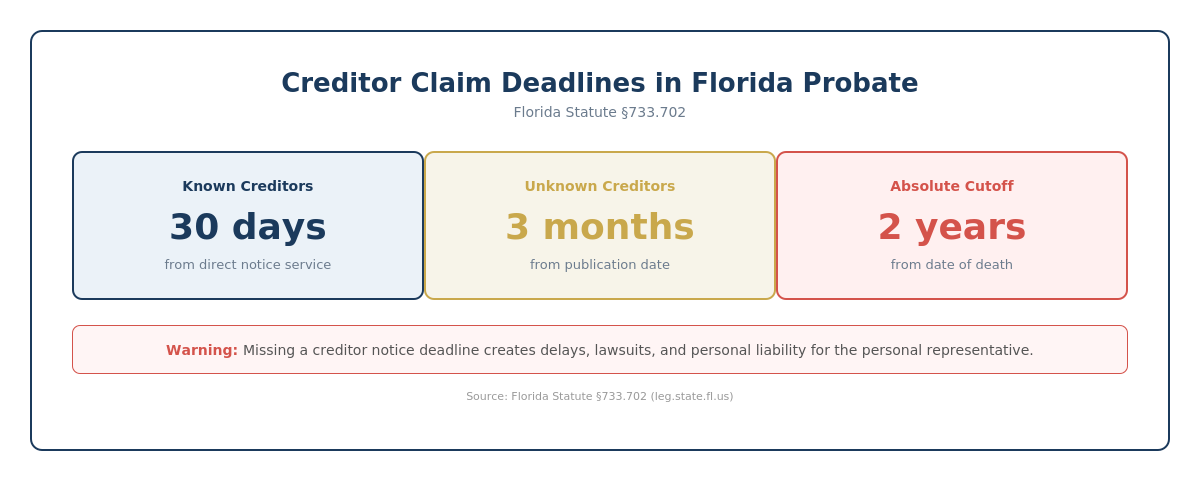
- Creditor deadlines are strict and non-negotiable. Known creditors get 30 days to respond after direct notice. Unknown creditors have 3 months from the date of publication. The absolute cutoff is 2 years from death under Florida Statute §733.702.
- Attorney and personal representative fees follow a statutory schedule based on estate value. For a $1 million estate, attorney fees alone run approximately $30,000 under Florida Statute §733.6171.
- Florida requires attorney representation for formal probate under Florida Probate Rule 5.030. The only exception: when the personal representative is the sole beneficiary.
- Tax obligations include up to three separate filings: the decedent’s final income tax return (Form 1040), estate income tax (Form 1041), and federal estate tax (Form 706) for estates exceeding the $15 million exemption.
- Early planning and expert guidance reduce delays, protect estate value, and prevent the personal representative from facing personal liability.
Introduction
When a Florida resident dies with an estate worth more than $75,000 in non-exempt assets, the estate must go through formal probate administration. This is a court-supervised process with detailed requirements at every stage.
Under Florida Statute §735.201, formal administration is mandatory for these larger estates. The process requires filing specific paperwork with the circuit court, appointing a personal representative, notifying creditors, valuing all assets, paying debts and taxes, and distributing remaining property to beneficiaries.
For families managing multiple properties, investment accounts, business interests, or retirement funds, the process is anything but simple. Questions come up fast:
- What are the exact steps in formal probate?
- How long does the process take for a large estate?
- What does the personal representative need to do, and by when?
- How much will probate cost?
- What happens if a creditor deadline is missed?
This guide walks through the entire Florida probate process for large estates in order, with exact timelines, cost breakdowns, and the specific legal requirements at each stage. Every section addresses the most common questions families face during this process.
What Triggers Formal Probate for a Large Estate in Florida?
Florida law creates two types of probate: summary administration and formal administration. The dividing line is $75,000 in non-exempt assets.
If the estate’s non-exempt assets exceed $75,000, or if the decedent died within the last two years and the estate is above the threshold, formal administration is required (Florida Statute §735.201).
Formal administration means:
- A personal representative is appointed by the court
- Full court supervision applies to every stage
- Attorney representation is mandatory under Florida Probate Rule 5.030
- Detailed inventories, accountings, and notices must be filed
“Non-exempt” assets are those owned solely by the decedent that do not pass automatically outside of probate. Exempt or non-probate assets include:
| Asset Type | Passes Through Probate? |
| Individually owned real estate | Yes |
| Sole-name bank accounts | Yes |
| Vehicles titled in decedent’s name only | Yes |
| Jointly owned property with right of survivorship | No |
| Life insurance with named beneficiary | No |
| Retirement accounts (IRA/401k) with named beneficiary | No |
| Payable-on-Death (POD) bank accounts | No |
| Assets held in a revocable living trust | No |
Source: The Florida Bar – Consumer Pamphlet: Probate in Florida (2026)
For estates near the $75,000 threshold, a detailed accounting of which assets require probate and which pass outside probate determines the correct path.
What Are the Steps in Florida Formal Probate for Large Estates?
Formal probate in Florida follows a specific sequence. Each step has deadlines and requirements under the Florida Probate Code (Chapters 731 through 735 of the Florida Statutes).
 Source: Florida Statutes §733.702, §735.201 | IRS Form 706 Instructions
Step 1: Filing the Will and Petition for Administration (2 to 6 Weeks)
The process begins when someone files the decedent’s original will with the circuit court in the county where the decedent lived at the time of death. Florida law requires the will to be deposited with the court clerk within 10 days of learning of the death (Florida Statute §732.901).
After filing the will, the next step is a Petition for Administration. This petition includes:
- The original will (if one exists)
- A certified death certificate
- Information about the decedent’s beneficiaries and heirs
- The proposed personal representative’s acceptance of the role
- A preliminary asset summary
The court reviews the petition, confirms the will’s validity, and appoints the personal representative. Once appointed, the judge issues “Letters of Administration,” giving the personal representative legal authority to act on behalf of the estate (Mary Conte Law, 2026).
Court filing fees typically range from $300 to $500 depending on the county (Lorenzo Law, 2025).
Step 2: Creditor Notification and Claims Period (3 Months Minimum)
After appointment, the personal representative must notify all creditors. This is one of the most deadline-sensitive parts of probate.
Two types of notice are required:
- Known creditors (hospitals, credit card companies, mortgage lenders, nursing homes) must receive direct written notice
- Unknown creditors are notified through a Notice to Creditors published in a local newspaper once a week for two consecutive weeks
 Source: Florida Statute §733.702
Under Florida Statute §733.702:
- Known creditors have 30 days from direct notice to file claims
- Unknown creditors have 3 months from the first publication date
- The absolute cutoff for all creditor claims is 2 years from the date of death
Missing any creditor notification deadline exposes the personal representative to personal liability. This is a common and expensive mistake in large estates with multiple debts, business obligations, or medical bills.
Newspaper publication costs typically run $75 to $200 (Adrian Philip Thomas, P.A., 2025).
Step 3: Asset Inventory and Valuation (1 to 3 Months)
The personal representative must identify, locate, and value every asset in the estate. Florida requires a formal inventory to be filed with the court.
This inventory must include:
- All real estate (including out-of-state property)
- Bank and brokerage accounts
- Business interests
- Vehicles, jewelry, art, and collectibles
- Retirement accounts
- Life insurance (if payable to the estate)
- Digital assets and cryptocurrency
Each asset needs a fair market value as of the date of death. For real estate, businesses, and collectibles, professional appraisals are required. For bank accounts and investment accounts, statements showing the balance on the date of death are sufficient.
Large estates create more work at this stage because assets are often spread across multiple states, held at different institutions, or difficult to locate. One undisclosed account or overlooked asset will delay the entire process.
Step 4: Debt Payment and Tax Resolution (1 to 3 Months)
After the creditor claims window closes, the personal representative evaluates each claim and pays valid debts from estate funds. Florida law establishes a specific priority order for paying debts:
- Costs and expenses of administration
- Reasonable funeral, interment, and grave marker expenses
- Debts and taxes given preference under federal law
- Reasonable medical and hospital expenses from the last 60 days of illness
- Family allowance
- All other claims
Source: Florida Statute §733.707
The personal representative also files all required tax returns:
| Tax Return | Purpose | When to File |
| Form 1040 | Decedent’s final income tax | April 15 of year following death |
| Form 1041 | Estate income tax (if estate earns over $600) | April 15 or 15th day of 4th month after fiscal year ends |
| Form 706 | Federal estate tax (if gross estate exceeds $15M in 2026) | 9 months after death (6-month extension available) |
Source: IRS.gov
Florida does not impose a state estate tax or inheritance tax. The Florida Constitution prohibits these taxes. The federal estate tax exemption for 2026 is $15 million per individual ($30 million for married couples) under the One Big Beautiful Bill Act signed July 4, 2025 (IRS Form 706 Instructions, September 2025).
For more on the tax requirements, see our detailed guide: Tax Implications for a Large Probate Estate in Florida.
Step 5: Final Accounting, Distribution, and Closing (1 to 3 Months)
The final stage requires the personal representative to:
- Prepare a detailed final accounting showing all assets, income, expenses, debts paid, and remaining balances
- Submit the accounting to the court for approval
- Obtain court approval for a plan of distribution
- Distribute remaining assets to beneficiaries according to the will (or Florida intestacy law if no will exists)
- File a petition for discharge to officially close the probate estate
Beneficiaries have the right to review the final accounting and file objections. If the court finds the accounting incomplete or inaccurate, the estate stays open until the issues are resolved (Ellis Law Group, 2022).
What Does the Personal Representative Do During Probate?
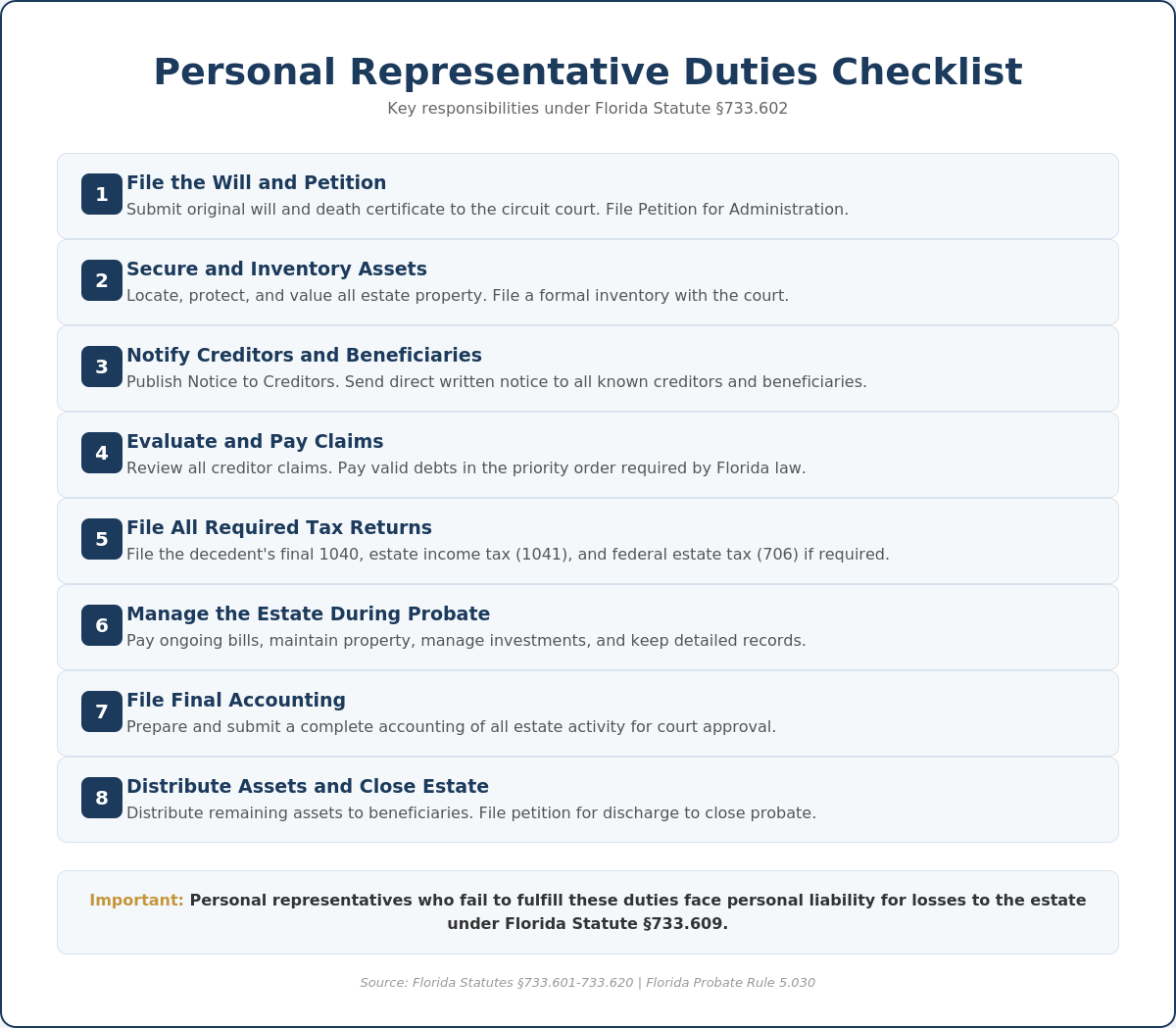
The personal representative (called an “executor” in many other states) is the person legally responsible for managing the entire probate process. This is a fiduciary role with significant legal duties under Florida Statute §733.602.
 Source: Florida Statutes §733.601-733.620 | Florida Probate Rule 5.030
Who Qualifies to Serve as Personal Representative in Florida?
Florida law sets specific eligibility requirements:
- Must be at least 18 years old
- Must be mentally and physically able to perform the duties
- Must not have a felony conviction
- Must be a Florida resident, OR a close relative of the decedent (spouse, parent, child, sibling) even if living out of state
Non-resident individuals who are not closely related to the decedent are not eligible to serve. Florida-authorized banks and trust companies also qualify (The Florida Bar, 2026).
What Happens If the Personal Representative Makes Mistakes?
Under Florida Statute §733.609, a personal representative who improperly exercises their powers or breaches their fiduciary duty faces personal financial liability. The court has authority to:
- Surcharge the personal representative for losses caused by mismanagement
- Remove and replace the personal representative
- Require additional bonding to protect the estate
Common mistakes in large estates include missing tax filing deadlines, distributing assets before all debts are paid, failing to notify a known creditor, and undervaluing estate property. Each of these creates grounds for legal action against the personal representative.
How Much Does Probate Cost for a Large Estate in Florida?
Probate costs for large estates involve multiple expense categories. The total cost depends on estate value, complexity, and whether disputes arise.
Attorney Fees
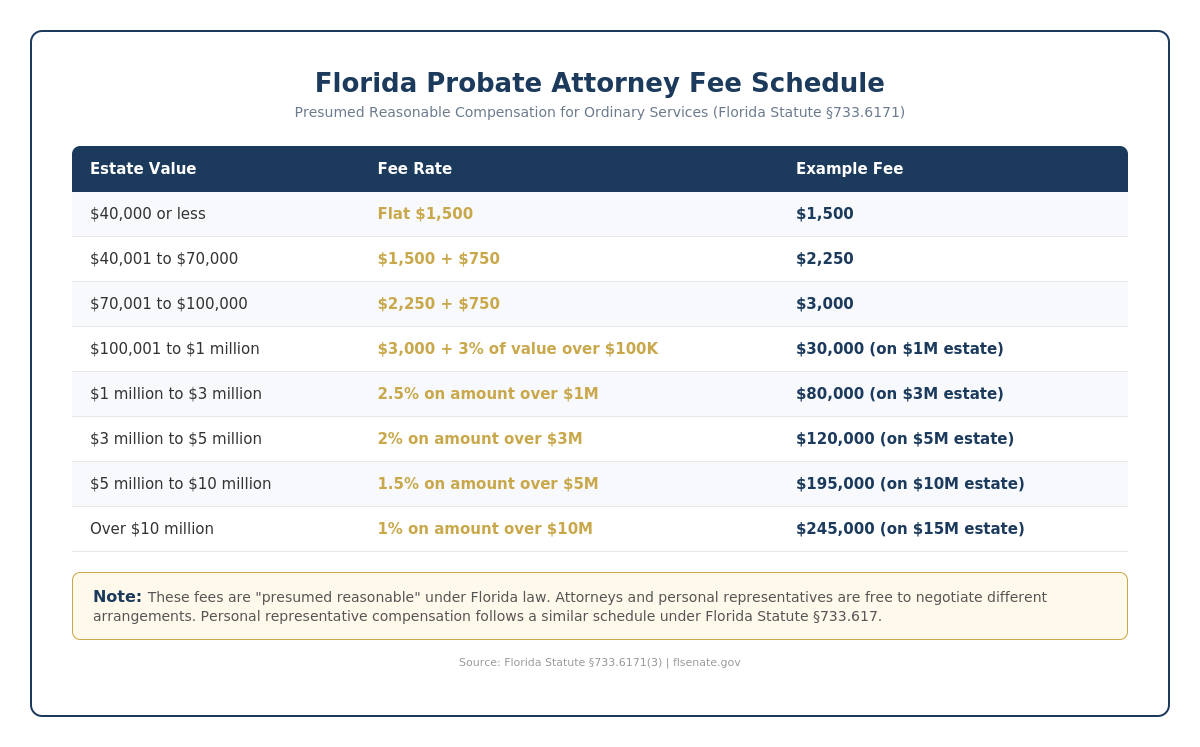
Florida Statute §733.6171 provides a statutory fee schedule for attorney compensation in formal probate. These fees are “presumed to be reasonable” and are based on the compensable value of the estate:
 Source: Florida Statute §733.6171(3) | flsenate.gov
For a $2 million estate, attorney fees under this schedule are approximately $55,000 for ordinary services. Extraordinary services (will contests, tax planning, real estate sales, IRS audits) trigger additional fees above the schedule.
These fees are negotiable. Florida law requires attorneys to disclose in writing to the personal representative that the fee is not mandatory and is subject to negotiation (Florida Statute §733.6171(2)(b)).
Personal Representative Compensation
Personal representatives are also entitled to compensation following a similar fee schedule under Florida Statute §733.617. This means a $2 million estate pays approximately $55,000 to the attorney and a similar amount to the personal representative.
Other Probate Costs
| Cost Category | Typical Range |
| Court filing fees | $300 to $500 |
| Newspaper publication (Notice to Creditors) | $75 to $200 |
| Certified death certificates (10+ copies) | $100 to $200 |
| Real estate appraisals | $300 to $600 per property |
| Business valuations | $5,000 to $25,000+ |
| Surety bond premiums | Varies by estate value |
| Accounting and CPA fees | $1,000 to $10,000+ |
Source: Florida Probate Costs Guide, 2025; SmartAsset, 2025
For a $1 million estate with no disputes, total probate costs (attorney fees, PR fees, court costs, and miscellaneous expenses) typically run $65,000 to $80,000. For a $5 million estate, expect costs of $200,000 or more.
How Long Does Formal Probate Take for a Large Estate?
The timeline for formal probate depends on estate complexity, whether disputes arise, and whether federal estate tax returns are required.
| Scenario | Expected Timeline |
| Uncontested estate, no Form 706 required | 6 to 12 months |
| Uncontested estate with Form 706 | 12 to 18 months |
| Estate with family disputes or will contest | 2 to 4 years |
| Estate with IRS audit on Form 706 | 3 to 5+ years |
Source: The Florida Bar (2026); IRS Form 706 Instructions
The minimum timeline is at least 3 months due to the mandatory creditor claims period. Even the simplest formal probate takes 5 to 6 months to complete properly (The Florida Bar, 2026).
Several factors extend the timeline for large estates:
- Multi-state property requiring ancillary probate in each state where real estate is located (Florida Statute §734.1025)
- Business interests requiring professional valuation
- Missing or disputed wills
- Creditor disputes or late claims
- Federal estate tax returns (Form 706 is due 9 months after death, with a 6-month extension available)
- Family conflicts or beneficiary disagreements
What Documents Do You Need to Start Florida Probate?
Gathering the right documents before filing speeds up the entire process. Missing paperwork causes delays of weeks to months.
Essential documents to assemble before your first court date:
- Certified death certificates (order 10 or more copies)
- The most recent, original will and any amendments (codicils)
- Acceptance of personal representative
- Comprehensive asset inventory with account numbers and estimated values
- Trust documents (if applicable) and proof accounts are titled correctly
- Beneficiary designation forms for insurance, retirement, and POD/TOD accounts
- Prior court orders or business agreements tied to the estate
- Recent financial statements and tax returns (last 3 years)
- Real property deeds, mortgage documents, and title insurance
- Vehicle titles
A single missing document, particularly a missing original will, triggers court hearings, delays, and additional legal fees. If the original will is lost, the personal representative must prove the will’s contents through secondary evidence, which adds months to the timeline.
What Happens If Someone Contests the Will?
Will contests are the most common source of delay and expense in large Florida estates. A contest is a formal legal challenge to the validity of the will.
Grounds for contesting a will in Florida include:
- Improper execution: The will was not signed, witnessed, or notarized according to Florida law (Florida Statute §732.502)
- Lack of testamentary capacity: The decedent did not understand what they were signing
- Undue influence: Someone pressured the decedent into changing the will
- Fraud or forgery: The will was forged or the decedent was tricked into signing
Will contests in large estates often double or triple both costs and timelines. One disputed estate in South Florida saw $30,000 in additional legal fees and two extra years of litigation over asset valuation disagreements.
To reduce the risk of will contests, families should:
- Request that the decedent use a self-proving affidavit when signing the will
- Keep detailed records of the decedent’s mental capacity at the time of signing
- Work with independent witnesses who are not beneficiaries
- Communicate estate plans clearly with family members in advance
How Do You Avoid or Reduce Probate for a Large Florida Estate?
Several legal tools allow assets to pass to beneficiaries without going through probate or reduce the size of the probate estate:
- Revocable living trust: Assets titled in the trust pass directly to beneficiaries outside of probate
- Payable-on-Death (POD) accounts: Bank accounts with designated beneficiaries bypass the court process
- Transfer-on-Death (TOD) registrations: Investment accounts with TOD designations transfer automatically
- Joint ownership with right of survivorship: Property passes directly to the surviving owner
- Lady Bird deeds: Allow Florida homestead property to pass to named beneficiaries without probate while preserving homestead protections during the owner’s lifetime
- Beneficiary designations on retirement accounts and life insurance: These assets pass directly to the named beneficiary
A combination of these tools, set up in advance, is the most effective way to reduce the time, cost, and complexity of probate for your family. For large estates, a properly funded revocable living trust is often the most comprehensive solution.
For detailed guidance on estate planning strategies, visit: Large Estate Probate Services at SJF Law Group.
Frequently Asked Questions
1. What is the probate process for a large estate in Florida?
Large estates (over $75,000 in non-exempt assets) go through formal administration under Florida Statute §735.201. The process involves five stages: filing the will and petition for administration, notifying creditors, inventorying and valuing assets, paying debts and filing taxes, and distributing remaining assets to beneficiaries. The court supervises every step, and attorney representation is mandatory.
2. How long does probate take for a large estate in Florida?
Standard formal probate takes 6 to 12 months for uncontested estates. Estates requiring federal estate tax filings (Form 706) take 12 to 18 months. If disputes, will contests, or IRS audits occur, the process extends to 2 to 5 years or longer. The mandatory 3-month creditor claims period sets the minimum timeline.
3. How much does probate cost for a large Florida estate?
Costs depend on estate value and complexity. Attorney fees follow a statutory schedule under Florida Statute §733.6171, starting at 3% for estates over $100,000 and decreasing to 1% for estates over $10 million. A $1 million estate pays approximately $30,000 in attorney fees alone. Add personal representative fees, court costs, appraisals, and CPA fees, and total costs for a $1 million estate typically reach $65,000 to $80,000.
4. What does a personal representative do during Florida probate?
The personal representative (executor) manages the entire probate process. Duties include filing the will and petition, locating and securing all assets, notifying creditors and beneficiaries, paying valid debts, filing all required tax returns, preparing a final accounting for court approval, and distributing assets to beneficiaries. The personal representative faces personal liability for errors under Florida Statute §733.609.
5. Does Florida have an estate tax or inheritance tax?
No. Florida does not have a state estate tax or inheritance tax. The Florida Constitution prohibits these taxes. Florida residents only face potential federal estate taxes if the estate exceeds the federal exemption, which is $15 million per individual ($30 million for married couples) for 2026 and beyond under the One Big Beautiful Bill Act.
6. What happens if a creditor is not properly notified during probate?
Missing a creditor notification deadline creates serious problems. The personal representative faces personal liability for any creditor claims that were not properly handled. Late claims delay asset distribution and freeze estate property. Under Florida Statute §733.702, known creditors get 30 days after direct notice, and unknown creditors get 3 months from publication. The absolute cutoff for all claims is 2 years from the date of death.
7. Do you need a lawyer for probate in Florida?
Yes, for formal administration. Florida Probate Rule 5.030 requires attorney representation in formal probate proceedings. The only exception is when the personal representative is the sole interested person (both the sole beneficiary and there are no creditors). For large estates with multiple assets, creditors, and beneficiaries, an experienced Florida probate attorney is essential.
8. What assets go through probate in Florida?
Assets owned solely by the decedent without a designated beneficiary must go through probate. This includes individually owned real estate, bank accounts in the decedent’s name only, vehicles, personal property, and business interests. Assets with named beneficiaries (life insurance, retirement accounts, POD/TOD accounts), jointly owned property with rights of survivorship, and assets in trusts pass outside of probate.
9. What is ancillary probate and when is it required?
Ancillary probate is a secondary probate proceeding required in any state where the decedent owned real property outside of Florida. If a Florida resident owned a vacation home in New York, for example, a separate probate proceeding must be opened in New York to transfer the property. This adds attorney fees, court costs, and months of additional time to the process.
10. How do you reduce or avoid probate for a large estate in Florida?
The most effective tools include a revocable living trust (properly funded with all major assets), Payable-on-Death and Transfer-on-Death account designations, joint ownership with right of survivorship, Lady Bird deeds for Florida homestead property, and keeping beneficiary designations current on retirement accounts and life insurance. A comprehensive estate plan created before death is the best way to reduce probate costs and delays.
Protecting Your Family Is a Phone Call Away
Planning for your future and protecting your loved ones requires action. A single phone call to SJF Law Group ensures your wishes are followed and your family is taken care of.
We guide individuals through the complex probate process and handle all aspects of the creation, administration, and settlement of trusts. When you work with the estate planning attorneys at SJF Law Group you get more than an estate plan: you get peace of mind.
Call us at 954-580-3690 or email us at info@estateandprobatelawyer.com today.