


What the Law Really Allows (and What It Doesn’t)
Many people assume that a will is the final word and that you can leave your assets to anyone you choose and exclude anyone you want.
But Florida law is not that simple.
In fact, there are strict legal protections that can override your will entirely, especially when it comes to spouses and minor children.
If you’re considering disinheriting a family member, understanding these rules is critical. One mistake can lead to court battles, unintended distributions, and your wishes being ignored.
This article explains who you can disinherit in Florida, who you cannot, and how to do it correctly.
Watch the Video: Can You Disinherit Family in Florida?
In this video, you’ll learn:
- Who you can legally disinherit in Florida
- The major legal protections for spouses and children
- Common estate planning mistakes
- How to ensure your wishes are actually enforced
Quick Answer
Yes, you can disinherit certain family members in Florida, but not everyone.
- You can disinherit adult children and most relatives
- You generally cannot fully disinherit a spouse without a legal agreement
- You cannot completely disinherit minor children
Florida law prioritizes protecting immediate family members, even over your written wishes.
The Biggest Misconception About Disinheritance
Many people believe that simply leaving someone out of a will is enough.
That’s a dangerous assumption.
If you:
- Omit a child’s name
- Fail to clearly state your intent
A court may assume it was a mistake, especially if the will was created before that person was born.
Result
- Legal disputes
- Delays in probate
- Potential redistribution of your estate
Fix
Use clear, explicit language stating your intent to disinherit.
Who You CAN Disinherit in Florida
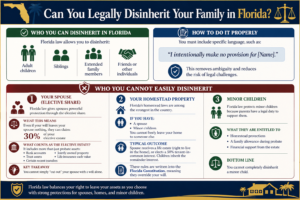
Florida law allows you to disinherit:
- Adult children
- Siblings
- Extended family members
- Friends or other individuals
How to Do It Properly
You must include specific language, such as:
“I intentionally make no provision for [Name].”
This removes ambiguity and reduces the risk of legal challenges.
Who You CANNOT Easily Disinherit
1. Your Spouse (Elective Share)
Florida law gives spouses powerful protection through the elective share.
What This Means
Even if your will leaves your spouse nothing, they can claim:
30% of your elective estate
What Counts as the Elective Estate?
It includes more than just probate assets:
- Bank accounts
- Trust assets
- Jointly owned property
- Life insurance cash value
- Certain recent transfers
Key Takeaway
You cannot simply “cut out” your spouse with a will alone.
2. Your Homestead Property
Florida’s homestead laws are among the strongest in the country.
If You Have:
- A spouse
- Minor children
You cannot freely leave your home to someone else.
Typical Outcome
- Spouse receives a life estate (right to live in the home), or elects a 50% tenant-in-common interest
- Children inherit the remainder interest
These rules are written into the Florida Constitution, meaning they override your will.
3. Minor Children
Florida law protects minor children because parents have a legal duty to support them.
What They Are Entitled To
- Homestead protections
- A family allowance during probate
- Financial support from the estate
Bottom Line
You cannot completely disinherit a minor child.
How to Legally Disinherit a Spouse (The Right Way)
There is only one reliable method:
Prenuptial or Postnuptial Agreement
To waive inheritance rights, your spouse must:
- Sign a written agreement
- Do so voluntarily
- Fully understand what they are giving up
Best Practice
Both spouses should have separate legal counsel to make the agreement enforceable.
Why DIY Estate Plans Fail
Many do-it-yourself estate plans break down because they:
- Ignore elective share rules
- Misunderstand homestead restrictions
- Use vague or incomplete language
- Fail to update documents
Result
- Litigation
- Delayed inheritance
- Assets distributed differently than intended
What About “No-Contest” Clauses?
You might think a no-contest clause will prevent challenges.
In Florida:
They are not enforceable.
This means:
- Beneficiaries can challenge your will
- There is no penalty for doing so
Key Insight
The only protection is a properly drafted, legally sound estate plan.
How to Make Your Wishes Legally Enforceable
To ensure your plan holds up:
- Use clear, explicit language
- Understand spousal and child protections
- Structure assets properly (trusts, titling, etc.)
- Keep documents updated
- Work with an experienced estate planning attorney
Estate planning is not just about what you want—it’s about what the law will enforce.
Key Takeaways
- You can disinherit adult children and most relatives
- Spouses have a legal right to 30% of the estate
- Homestead laws can override your will
- Minor children cannot be fully disinherited
- No-contest clauses do not work in Florida
- Proper planning is essential to enforce your wishes
When to Speak With an Estate Planning Attorney
Disinheriting a family member is one of the most complex areas of Florida estate planning, and one of the easiest places to make costly mistakes.
At SJF Law Group, our attorneys bring advanced degrees and deep tax expertise to help clients:
- Structure estate plans that comply with Florida law
- Navigate elective share and homestead rules
- Draft clear, enforceable documents
- Protect assets and minimize disputes
If you are considering disinheriting someone, getting legal guidance early is critical.
Schedule a consultation today to ensure your wishes are properly protected.
Frequently Asked Questions (FAQ)
Can I disinherit my child in Florida?
Yes, but only if they are an adult, and you must clearly state your intent in your will.
Can I disinherit my spouse?
Not without a valid prenuptial or postnuptial agreement. Otherwise, they can claim 30% of your estate.
Can I leave my house to someone other than my spouse?
Not if you have a spouse or minor children. Florida homestead laws restrict this.
Are no-contest clauses enforceable in Florida?
No. They do not prevent someone from challenging your will.
What happens if I don’t have a valid will?
Florida law decides who inherits your assets, typically your spouse and children.