


Key Takeaways
When a Florida estate includes more than one property, each parcel follows its own path through (or around) probate. Every family should know these essential points:
- The personal representative evaluates each property in a Florida estate individually for probate. The personal representative must examine the deed, titling method, and homestead status of every parcel. One estate with five properties might send three through probate and two directly to beneficiaries.
- Property titled solely in the decedent’s name is a probate asset. Under Florida Probate Code Chapters 731-735, real estate owned outright by the decedent requires court-supervised administration before it transfers to heirs or beneficiaries.
- Homestead property sits outside the probate estate, but it still requires a court order. Under Florida Statute 733.607, the personal representative holds no authority over homestead property. The court must issue an Order Determining Homestead Status before the property transfers.
- Investment properties, rental units, and vacation homes titled in the decedent’s sole name all go through probate. Only the decedent’s primary residence qualifies for homestead protection. Every other property is a standard probate asset.
- Joint tenancy with right of survivorship and tenancy by the entirety bypass probate entirely. These titling methods pass ownership automatically to the surviving co-owner at death, with no court involvement.
- A revocable living trust removes real estate from the probate estate. Properties deeded into a trust before death transfer to the successor trustee without court supervision, saving months of delays and thousands in attorney fees.
- An enhanced life estate deed (Lady Bird Deed) is a lower-cost alternative to a trust for individual properties. The owner retains full control during their lifetime, and the property passes to the named beneficiary at death without probate.
- Out-of-state property owned by a Florida resident requires ancillary probate in the state where the property sits. Each state runs its own separate proceeding, adding filing fees, attorney costs, and months to the timeline.
- Multiple heirs inheriting the same property often face partition actions. When beneficiaries disagree on keeping or selling inherited real estate, any co-owner has the right to file a partition lawsuit forcing a sale.
- Strategic estate planning eliminates probate for every property in the portfolio. A combination of trusts, Lady Bird Deeds, and proper titling keeps multi-property estates out of court entirely.
Introduction
Florida residents who own more than one property face a question their families rarely consider until it is too late: which of these properties will go through probate?
The answer depends on how each property is titled, whether it qualifies as homestead, and whether the owner put any estate planning tools in place before death. A family with a primary residence, a beach condo, and a rental duplex might find one property bypassing probate completely, one requiring a special court order, and one sitting in a probate case for 6 to 12 months.
For families managing large estate probate services, the stakes multiply with every additional parcel. More properties mean more complexity, higher costs, and a longer timeline to close the estate.
This article breaks down exactly which properties go through probate, which ones do not, how homestead status changes the rules, what ancillary probate means for out-of-state holdings, and how smart estate planning keeps every property in a portfolio out of probate court.
 Florida estates with multiple properties require individual probate analysis for each parcel
What Happens When a Florida Estate Includes Multiple Properties?
When someone dies owning real estate in Florida, the personal representative (executor) must evaluate each property on its own. No blanket rule covers the entire portfolio. The personal representative classifies each parcel as a probate asset or a non-probate asset based on three factors:
- How the deed is titled (sole ownership, joint ownership, trust, or other arrangement)
- Whether the property qualifies as homestead (primary residence with constitutional protections)
- Where the property is located (Florida property vs. out-of-state property)
The personal representative’s first job after appointment is to inventory every real estate holding and determine the legal path for each one. Under Florida Statute 733.607, the personal representative takes possession of all probate assets, but homestead property sits outside their authority entirely.
Why Does This Property-by-Property Analysis Matter?
Families who skip this step create problems. Treating all properties the same way leads to:
- Unnecessary probate filings for properties held in trusts or joint ownership
- Missed homestead protections for the primary residence
- Delayed distributions when the personal representative does not realize a property passes automatically to a surviving co-owner
- Tax consequences from losing the Save Our Homes property tax cap on the homestead
A thorough property audit at the start of estate administration saves time, money, and family conflict.
Which Types of Real Estate Go Through Probate in Florida?
The type of property does not determine probate status. A mansion, a mobile home, a vacant lot, and a commercial building all follow the same rule: the deed title controls whether the property enters probate.
What Types of Real Estate Are Probate Assets?
Real estate enters probate when titled in any of these ways:
- Sole ownership: Property deeded only in the decedent’s name with no survivorship language, no trust, and no co-owner. This scenario triggers probate more often than any other.
- Tenants in common: Property owned by two or more people where each person holds a separate, divisible share. When one owner dies, their share does not pass to the other owner. It becomes a probate asset of the deceased owner’s estate. According to the Florida Bar’s Probate Consumer Pamphlet (2026), “real estate titled in the sole name of the decedent, or the decedent’s name and another person as tenants in common, is a probate asset.”
What Types of Real Estate Bypass Probate?
These titling methods transfer property automatically at death, with no court involvement:
- Joint tenancy with right of survivorship: Ownership passes to the surviving joint tenant by operation of law at death
- Tenancy by the entirety: Available only to married couples. The surviving spouse receives full ownership automatically. This form of title also provides creditor protection during the owners’ lifetimes.
- Property held in a revocable living trust: The trust owns the property, not the individual. When the trust creator dies, the successor trustee distributes or manages the property per the trust instructions.
- Property transferred by enhanced life estate deed (Lady Bird Deed): The owner keeps full control and ownership during life, and the property passes to the named remainder beneficiary at death without probate.
| Titling Method | Goes Through Probate? | Automatic Transfer? | Creditor Protection? |
| Sole ownership | Yes | No | None |
| Tenants in common | Yes (deceased owner’s share) | No | None |
| Joint tenants with right of survivorship | No | Yes, to surviving owner | None |
| Tenancy by the entirety (married couples) | No | Yes, to surviving spouse | Yes, from individual debts |
| Revocable living trust | No | Yes, per trust terms | None during lifetime |
| Enhanced life estate deed (Lady Bird Deed) | No | Yes, to remainder beneficiary | Owner retains homestead protection |
Figure 1: Real Estate Titling Methods and Probate Status in Florida – Source: Florida Bar Probate Consumer Pamphlet (2026), Florida Probate Litigation Blog (2026)
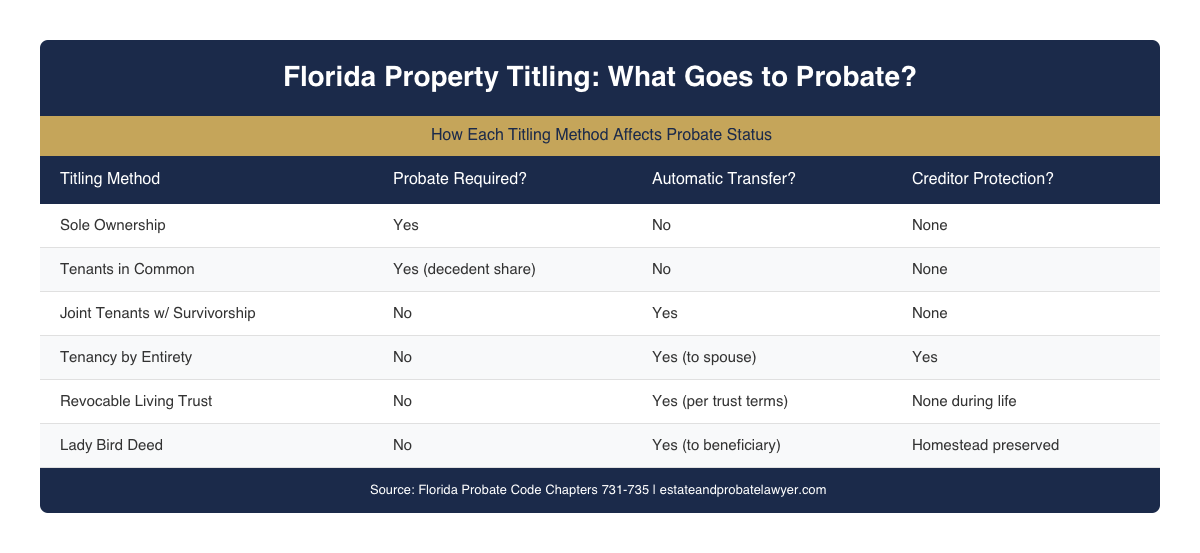 Florida Property Titling: What Goes to Probate?
Does Homestead Property Go Through Probate in Florida?
Homestead is the single most misunderstood area of Florida probate law. The short answer: homestead property does not qualify as a probate asset, but it still requires court involvement to transfer.
Under Florida Statute 733.607, the personal representative has the right to take possession of all estate assets “except the protected homestead.” The Florida Constitution, Article X, Section 4, provides homestead property with special protections from creditors and restrictions on how the owner transfers it at death.
How Does Florida Define Homestead Property?
To qualify as homestead under Florida law, the property must meet two requirements:
- The decedent used the property as their primary residence at the time of death.
- It falls within the size limits: up to 1/2 acre within a municipality, or up to 160 acres outside a municipality.
A person holds only one homestead at a time. The following properties never qualify:
- Vacation homes
- Second homes
- Rental properties
- Investment properties
- Commercial buildings
- Vacant land (unless used as the primary residence under specific circumstances)
What Court Steps Are Required for Homestead Property?
Even though homestead falls outside the probate estate, the personal representative must still involve the probate court. The court issues an Order Determining Homestead Status, which:
- Confirms the property qualifies as homestead
- Identifies the surviving spouse and/or minor children
- Determines how the property passes (per the will, by intestate succession, or by constitutional requirements)
- Addresses any devise restrictions under Florida Statute 732.4015
Title companies require this order before insuring any future sale or refinance of the property. Without it, title companies will not insure the property.
How Does Homestead Status Restrict Who Inherits the Property?
When the decedent leaves behind a surviving spouse or minor children, the homestead passes under strict constitutional rules, regardless of what the will says:
| Family Situation | How Homestead Passes |
| Surviving spouse, no minor children | Spouse receives fee simple title (if will devises to spouse) or life estate with remainder to descendants |
| Surviving spouse and minor children | Spouse receives life estate, children get remainder. Spouse has the option to elect a 1/2 undivided interest as tenant in common within 6 months. |
| Minor children, no surviving spouse | Children inherit fee simple title |
| No surviving spouse, no minor children | Property passes per the will to any beneficiary |
Figure 2: Homestead Property Distribution Rules in Florida
Source: SJF Law Group (2025), Florida Probate Law Group (2026)
What Happens to the Save Our Homes Cap When Homestead Transfers?
This is the hidden cost most families overlook. Florida’s Save Our Homes amendment caps annual property tax assessment increases at 3% for homestead properties. When the homestead transfers to heirs (other than a surviving spouse who already holds homestead rights), the property is reassessed at full market value.
For a property with decades of Save Our Homes protection, the reassessment creates a significant property tax increase. A home assessed at $200,000 under the cap but worth $500,000 at market value will see its tax assessment jump by $300,000. At a combined millage rate of 18 mills, the annual property tax increase would be approximately $5,400.
The surviving spouse who already lives in the property and claims homestead retains the cap. All other heirs lose it.
What Happens to Investment and Rental Properties in a Florida Estate?
Investment properties, rental units, vacation homes, and commercial real estate do not receive homestead protection. When titled in the decedent’s sole name, these properties are straightforward probate assets.
How Does Probate Handle Non-Homestead Real Estate?
Non-homestead property in the probate estate follows the standard administration process:
- The personal representative takes possession under Florida Statute 733.607
- The property is inventoried and appraised as part of the estate inventory (due within 60 days of appointment)
- The property is subject to creditor claims during the 3-month creditor period
- The personal representative manages the property during administration (collecting rent, paying expenses, maintaining insurance)
- The property is distributed to beneficiaries per the will, or sold and proceeds distributed
Unlike homestead, non-homestead real estate has no creditor protection. Creditors of the estate hold the right to seek payment from the proceeds of these properties.
Does Rental Income During Probate Create Tax Obligations?
Yes. When rental properties continue generating income during probate, the estate must report the income. The IRS requires an estate income tax return (Form 1041) when gross income exceeds $600 per year. Rental income, minus deductible expenses like mortgage interest, property taxes, insurance, and maintenance, flows through to the estate’s tax return.
The personal representative is responsible for filing these returns and paying any taxes owed from estate funds.
How Does Property Titling Determine Probate Requirements?
The deed recorded with the county clerk’s office controls everything. The personal representative must pull the most recent deed for every property in the estate and verify the exact language on the title.
What Is the Difference Between Tenants in Common and Joint Tenants With Right of Survivorship?
These two forms of co-ownership produce opposite results in probate:
Tenants in common (TIC):
- Each owner holds a separate percentage interest (not necessarily equal)
- When one owner dies, their interest does NOT pass to the other owner
- The deceased owner’s share enters their probate estate
- The surviving owner and the estate’s beneficiaries become co-owners
Joint tenants with right of survivorship (JTWROS):
- Each owner holds an equal, undivided interest
- When one owner dies, their interest passes automatically to the surviving owner
- The property skips probate entirely
- The surviving owner holds full ownership by operation of law
The difference between these two titling methods is a single phrase on the deed: “with right of survivorship.” Without those words, Florida law presumes the owners hold as tenants in common, and the deceased owner’s share enters probate.
How Does Tenancy by the Entirety Work in Florida?
Only married couples hold access to tenancy by the entirety. Under Florida law, when a married couple acquires real property together, the law presumes they hold as tenants by the entirety unless the deed states otherwise.
Key features:
- The surviving spouse automatically receives full ownership at death
- The property skips probate
- During both spouses’ lifetimes, the property enjoys protection from the individual debts of either spouse
- Creditors of only one spouse hold no right to force a sale or place a lien on the property
- Both spouses must agree to sell, mortgage, or transfer the property
For families with multiple properties, titling investment properties as tenants by the entirety (when both spouses own them) provides both probate avoidance and creditor protection.
 Proper property titling decisions made during estate planning determine whether each property enters probate
How Does Ancillary Probate Work for Out-of-State Properties?
When a Florida resident dies owning real property in another state, the primary probate case in Florida does not transfer authority over out-of-state property. Each state has jurisdiction only over real estate within its borders.
The result: the family must open a separate probate proceeding (called ancillary probate) in every state where the decedent owned real property.
What Does Ancillary Probate Require?
According to Nolo (2024), ancillary probate involves:
- Filing a petition in the probate court of the state where the property is located
- Appointing a personal representative who meets the other state’s qualifications (some states require a state resident)
- Complying with the other state’s probate procedures, creditor notice requirements, and timelines
- Paying separate filing fees and attorney costs in each state
What Are the Costs of Ancillary Probate?
Each ancillary proceeding adds:
| Cost Category | Typical Range |
| Court filing fees (per state) | $200 to $500 |
| Attorney fees (per state) | $2,000 to $10,000+ |
| Personal representative bond (if required) | $500 to $2,000 |
| Publication/notice costs | $100 to $300 |
| Certified document fees | $50 to $150 |
Figure 3: Ancillary Probate Costs Per Additional State
Source: Nolo (2024), Trust & Will (2026)
For a Florida resident who owns a cabin in North Carolina and a condo in New York, the family faces three separate probate proceedings (domiciliary probate in Florida plus ancillary probate in two other states), each with its own attorney, its own timeline, and its own costs.
How Does a Family Avoid Ancillary Probate?
The most effective strategy is to deed out-of-state property into a revocable living trust before death. Since the trust (not the individual) owns the property, no state requires a probate proceeding. A Lady Bird Deed works in states recognizing this instrument, though not all states do.
What Are the Costs of Probating Multiple Properties in One Florida Estate?
Each property in probate adds to the estate’s costs. The more properties, the higher the total.
How Do Costs Scale With Multiple Properties?
| Cost Category | 1 Property | 3 Properties | 5 Properties |
| Court filing fees | $300-$500 | $300-$500 | $300-$500 |
| Property appraisals | $300-$600 | $900-$1,800 | $1,500-$3,000 |
| Title searches (per property) | $200-$400 | $600-$1,200 | $1,000-$2,000 |
| Attorney fees (statutory, on estate value) | $1,500-$3,000 | $3,000-$7,500 | $4,500-$15,000 |
| Personal representative compensation | Same statutory scale | Same statutory scale | Same statutory scale |
| Property maintenance during probate | $200-$500/mo | $600-$1,500/mo | $1,000-$2,500/mo |
| Insurance premiums (per property) | $100-$300/mo | $300-$900/mo | $500-$1,500/mo |
| Estimated total over 8-month probate | $5,000-$12,000 | $12,000-$30,000 | $20,000-$55,000 |
Figure 4: Estimated Probate Costs by Number of Properties in a Florida Estate
Source: Florida Bar Probate Consumer Pamphlet (2026), Skatoff Law (2025)
Attorney fees in Florida follow a statutory schedule based on the total value of the probate estate:
| Estate Value | Attorney Fee |
| First $40,000 | $1,500 |
| $40,001 – $70,000 | $2,250 |
| $70,001 – $100,000 | $3,000 |
| $100,001 – $1,000,000 | $3,000 + 3% of value above $100,000 |
| $1,000,001 – $3,000,000 | $3,000 + 2.5% of value above $1,000,000 |
| $3,000,001 – $5,000,000 | $3,000 + 2% of value above $3,000,000 |
| $5,000,001 – $10,000,000 | $3,000 + 1.5% of value above $5,000,000 |
| Above $10,000,000 | Court determines reasonable fee |
Figure 5: Florida Statutory Attorney Fee Schedule for Probate
Source: Florida Statute 733.6171
For an estate with three investment properties worth a combined $1.5 million plus a $500,000 homestead, the probate estate value is $1.5 million (the homestead amount stays excluded). The statutory attorney fee alone would be approximately $15,250.
What Happens When Multiple Heirs Inherit the Same Property?
When a will distributes a single property to multiple beneficiaries (or when intestate succession gives equal shares to several children), the heirs become co-owners. This co-ownership often creates conflict.
What Is a Partition Action in Florida?
Under Florida partition law (2025), any co-owner of real property holds the right to file a partition action in court. A partition action forces the resolution of co-ownership, either by:
- Partition in kind: Physically dividing the property (rare for residential real estate)
- Partition by sale: Selling the property and dividing the proceeds among co-owners
Partition actions are expensive and adversarial. Attorney fees, court costs, and auctioneer/broker commissions reduce the total proceeds available for distribution. The average partition case costs $10,000 to $50,000 in legal fees alone, according to Zoecklein Law (2025).
How Does a Family Avoid Partition Disputes?
The best prevention strategies include:
- The will specifies whether each property should be sold or distributed. Clear instructions eliminate ambiguity.
- A buyout clause allows one heir to purchase other heirs’ shares. The will or trust sets a fair valuation method and timeline.
- A trust with detailed instructions removes the decision from the heirs entirely. The trustee follows the trust document, not the heirs’ preferences.
How Long Does Probate Take With Multiple Properties?
The timeline depends on the number of properties in probate, whether homestead is involved, and whether any out-of-state property requires ancillary proceedings.
What Is the Baseline Florida Probate Timeline?
| Phase | Duration |
| Petition for administration | 2 to 4 weeks |
| Letters of Administration issued | 30 to 90 days from filing |
| Property inventory and appraisals | 60 days from appointment |
| Creditor notice published | Within 10 days of appointment |
| Creditor claim period | 3 months from first publication |
| Creditor claim resolution | 1 to 3 months |
| Distribution to beneficiaries | After all claims resolved |
| Total minimum timeline | 5 to 8 months |
Figure 6: Florida Probate Timeline for Standard Formal Administration
Source: Florida Bar Probate Consumer Pamphlet (2026)
How Do Multiple Properties Extend the Timeline?
Each additional property adds complexity in several ways:
- Appraisals: Scheduling appraisals for 5 properties takes longer than for 1
- Homestead determination: If the estate includes a homestead property, the court must issue a separate order, adding 4 to 8 weeks
- Property management: Maintaining multiple vacant properties requires time, coordination, and expense
- Ancillary probate: Each out-of-state property adds 3 to 12 months for the separate proceeding
- Sales during probate: Selling multiple properties simultaneously or sequentially requires court approval (unless the will contains a power of sale clause), adding 3 to 5 weeks per sale
- Beneficiary disputes: More properties create more opportunities for disagreement, which slows distribution
A realistic timeline for a multi-property estate in Florida:
| Estate Complexity | Expected Timeline |
| 1 Florida property (non-homestead) | 5 to 8 months |
| 1 homestead + 1 non-homestead | 6 to 10 months |
| 3 Florida properties + homestead | 8 to 14 months |
| Multiple Florida + out-of-state properties | 12 to 24 months |
Figure 7: Estimated Probate Timeline by Estate Complexity
Source: Florida Probate Law Group (2026), Florida Bar (2026)
How Does a Revocable Living Trust Keep Multiple Properties Out of Probate?
A revocable living trust is the most effective tool for families who own more than one property. The trust serves as a container holding ownership of every property in the portfolio. When the trust creator (grantor) dies, the successor trustee distributes or manages the properties per the trust instructions, with no court involvement.
How Does the Trust Work for Real Estate?
The process is straightforward:
- Create the trust: An estate planning attorney drafts the revocable living trust document, naming the grantor as initial trustee and designating a successor trustee
- Fund the trust: The grantor executes new deeds transferring each property from their individual name to the trust. Example: “John Smith” becomes “John Smith, as Trustee of the John Smith Revocable Living Trust”
- Manage during lifetime: The grantor retains full control. They live in the property, collect rent, sell, refinance, and make all decisions
- Transfer at death: The successor trustee steps in, distributes properties to beneficiaries, or manages them per the trust terms
What Are the Advantages Over Probate for Multi-Property Owners?
| Factor | Probate | Revocable Living Trust |
| Court involvement | Required | None |
| Public record | Yes, probate filings are public | No, trust terms are private |
| Timeline to transfer | 5 to 24 months | Days to weeks |
| Attorney fees | Statutory schedule ($3,000 to $50,000+) | One-time trust creation ($2,000 to $5,000) |
| Out-of-state property | Ancillary probate required | No separate proceedings |
| Creditor claims | 3-month mandatory waiting period | No statutory waiting period (but creditors retain rights) |
Figure 8: Probate vs. Revocable Living Trust for Multi-Property Estates
Source: Karp Law (2026), DDPA Law (2026)
What Happens if the Trust Is Not Fully Funded?
This is the most common trust failure. The grantor creates a trust but fails to re-title one or more properties into the trust name. Any property still titled in the individual’s name at death goes through probate, defeating the purpose of the trust.
Families with multiple properties should conduct an annual “trust funding audit” to verify every property deed names the trust as owner. A single missed deed means a trip to probate court.
How Does an Enhanced Life Estate Deed (Lady Bird Deed) Work in Florida?
A Lady Bird Deed (formally called an enhanced life estate deed) is a simpler, less expensive alternative to a trust for individual properties. Florida is one of a small number of states recognizing this instrument.
What Makes a Lady Bird Deed Different From a Regular Life Estate Deed?
A standard life estate deed transfers a future interest to a remainder beneficiary immediately. The owner loses the right to sell, mortgage, or change the arrangement without the beneficiary’s consent.
A Lady Bird Deed keeps full control with the owner. The owner retains the right to:
- Sell the property
- Refinance or take out a mortgage
- Change the remainder beneficiary
- Revoke the deed entirely
At the owner’s death, the property passes to the named remainder beneficiary automatically, without probate. The transfer happens by operation of law.
When Is a Lady Bird Deed Better Than a Trust?
| Factor | Lady Bird Deed | Revocable Living Trust |
| Cost to create | $500 to $1,500 per property | $2,000 to $5,000 (covers all assets) |
| Covers multiple properties | Requires separate deed per property | Single trust covers all properties |
| Out-of-state property | Limited to states recognizing the instrument | Works in all states |
| Medicaid protection | Preserves homestead exemption, no transfer penalty | Revocable trust does not protect from Medicaid |
| Complexity | Simple, single document | More complex, requires funding |
| Changes | New deed required for any change | Trust amendment covers all changes |
Figure 9: Lady Bird Deed vs. Revocable Living Trust Comparison
Source: Rarick & Bowden Gold (2026), Karp Law (2026)
For a family with a single Florida property, a Lady Bird Deed is often the fastest and most affordable probate avoidance tool. For a family with five or more properties (especially in multiple states), a revocable living trust is the better choice because one document covers everything.
How Does Estate Planning Prevent Probate for Every Property in a Multi-Property Portfolio?
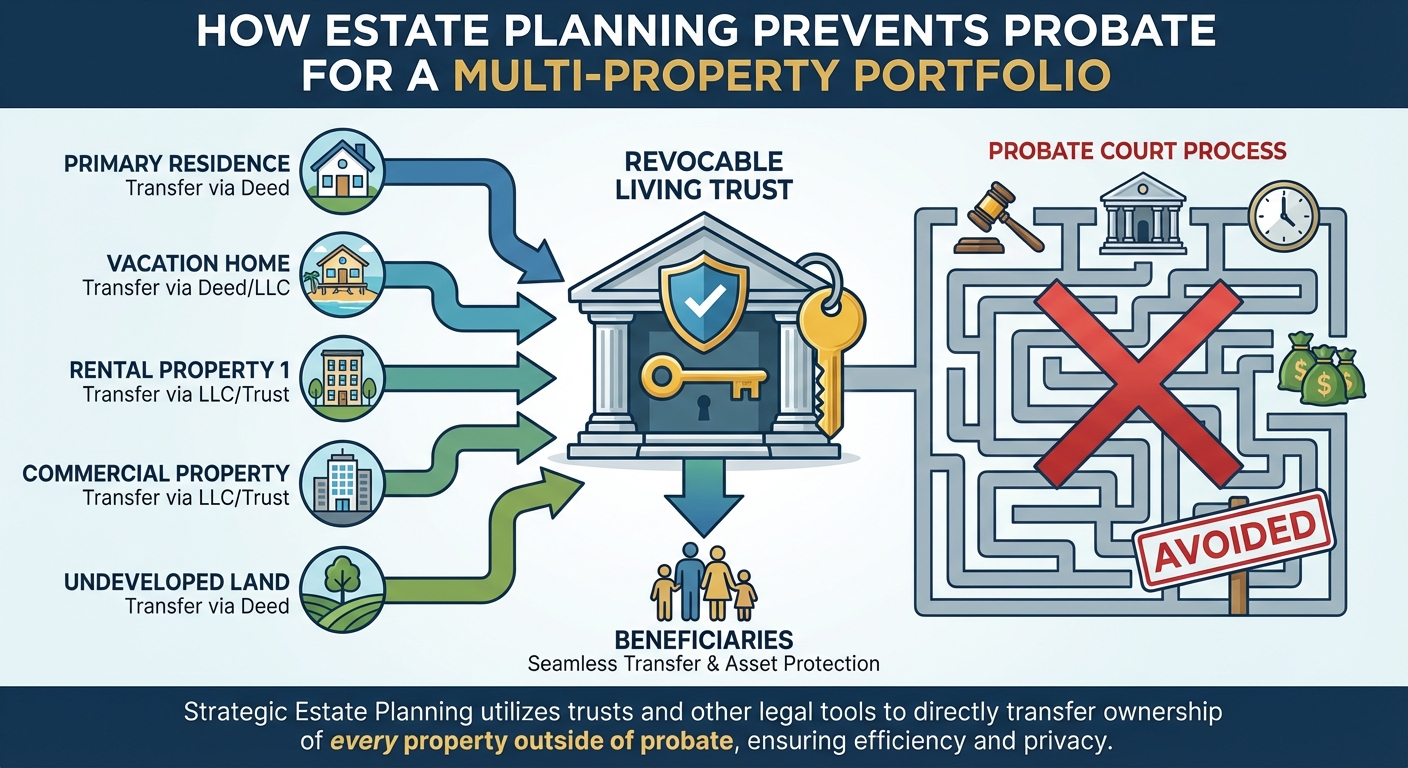 Families with multiple properties benefit from a property-by-property estate planning strategy
The goal is clear: no property should enter probate. Here is a property-by-property strategy framework:
Property Audit Checklist for Multi-Property Estates
| Property | Type | Current Title | Probate Status | Recommended Action |
| Primary residence | Homestead | Sole ownership | Court order required | Deed to trust or Lady Bird Deed |
| Beach condo | Non-homestead | Sole ownership | Full probate | Deed to trust |
| Rental duplex | Non-homestead | Tenants in common (with sibling) | Deceased owner’s share enters probate | Buy out co-owner or deed share to trust |
| Out-of-state cabin | Non-homestead | Sole ownership | Ancillary probate in other state | Deed to trust (avoids ancillary) |
| Vacant lot | Non-homestead | Sole ownership | Full probate | Deed to trust or Lady Bird Deed |
Figure 10: Sample Property Audit for a Multi-Property Estate
What Steps Should Every Multi-Property Owner Take?
- Pull the deed for every property. Verify the exact titling language on each deed recorded with the county clerk.
- Classify each property. Determine homestead vs. non-homestead, in-state vs. out-of-state, sole ownership vs. co-ownership.
- Work with an estate planning attorney to implement the right tool for each property. A trust covers the entire portfolio. Lady Bird Deeds work for individual Florida properties. Joint ownership with survivorship works for married couples.
- Update beneficiary designations on financial accounts. Properties are only part of the picture. Bank accounts, retirement accounts, and life insurance all need matching designations.
- Conduct annual audits. Every new property purchase, refinance, or title change requires updating the estate plan. A single missed deed sends a property to probate.
- Store documents where the family knows to find them. The best estate plan fails if the family does not know the trust exists or where the deeds are recorded.
Multi-Property Estate: Property Audit Process
Frequently Asked Questions
1. What assets do not pass through probate in Florida?
Assets titled with a right of survivorship, held in a revocable living trust, or carrying a valid beneficiary designation bypass probate in Florida. For real estate specifically, joint tenancy with right of survivorship, tenancy by the entirety, trust-titled property, and property transferred by Lady Bird Deed all pass outside of probate. Life insurance policies, retirement accounts, and payable-on-death bank accounts with named beneficiaries also avoid probate.
2. Does every property in a Florida estate go through probate?
No. Each property is evaluated individually based on how the deed is titled. Property in the decedent’s sole name or held as tenants in common goes through probate. Property held as joint tenants with right of survivorship, tenancy by the entirety, or in a revocable living trust bypasses probate. Homestead property is not a probate asset under Florida Statute 733.607, but it still requires a court order to transfer.
3. How does homestead status affect probate for the primary residence?
Homestead property is excluded from the probate estate under Florida Statute 733.607. The personal representative has no authority over homestead. The court issues a separate Order Determining Homestead Status, which identifies the property, confirms its qualification, and determines how it passes to heirs. When a surviving spouse or minor children exist, homestead passes under constitutional protections regardless of the will.
4. What happens to rental and investment properties in a Florida probate estate?
Rental properties, investment properties, and vacation homes titled in the decedent’s sole name are standard probate assets. They enter the probate estate, are subject to creditor claims, and follow the standard administration process. The personal representative manages these properties during probate, including collecting rent, paying expenses, and maintaining insurance. Rental income exceeding $600 per year requires an estate income tax return (IRS Form 1041).
5. What is the difference between tenants in common and joint tenants with right of survivorship?
Tenants in common each hold a separate share of the property. When one owner dies, their share enters their probate estate and passes to their heirs, not the other co-owner. Joint tenants with right of survivorship hold equal, undivided interests. When one owner dies, the surviving owner receives full ownership automatically by operation of law, with no probate required. The critical difference is the survivorship language on the deed.
6. How does ancillary probate work for out-of-state property?
When a Florida resident dies owning real estate in another state, a separate probate proceeding (ancillary probate) must be filed in the state where the property is located. The Florida probate court has no jurisdiction over out-of-state real estate. Each ancillary proceeding requires its own petition, personal representative appointment, compliance with local probate rules, and attorney. Costs range from $2,500 to $12,000 per state.
7. Does a revocable living trust avoid probate for all properties?
A revocable living trust avoids probate for every property properly deeded into the trust before the owner’s death. The trust holds legal ownership, so the property transfers to beneficiaries through the trust administration process with no court involvement. The critical requirement is funding: every property must have a deed recorded naming the trust as owner. Unfunded properties (still titled in the individual’s name) go through probate despite the trust’s existence.
8. What is a Lady Bird Deed and how does it avoid probate in Florida?
A Lady Bird Deed (enhanced life estate deed) is a legal instrument allowing a property owner to name a remainder beneficiary who receives the property at death, while the owner retains full control during life. The owner keeps the right to sell, mortgage, revoke, or change the beneficiary without consent. At death, the property passes to the remainder beneficiary by operation of law, bypassing probate. Florida is one of a limited number of states recognizing Lady Bird Deeds.
9. What happens when multiple heirs inherit the same Florida property?
When multiple heirs inherit the same property, they become co-owners. If all heirs agree on what to do (keep, sell, or rent), the process is smooth. When heirs disagree, any co-owner has the right to file a partition action in court, forcing a sale of the property. Partition actions are costly (averaging $10,000 to $50,000 in legal fees) and often result in below-market sale prices at auction.
10. How does a family prevent probate for a multi-property estate in Florida?
Prevention requires a property-by-property estate plan. The most effective approach is to deed all properties into a revocable living trust. For single Florida properties, a Lady Bird Deed is a lower-cost alternative. Married couples benefit from titling properties as tenancy by the entirety. Every property needs a deed review, proper titling, and periodic audits to verify trust funding. An estate planning attorney creates a unified strategy covering every parcel in the portfolio.
Protecting Your Family Is a Phone Call Away
Ancillary probate adds time, expense, and complexity for families dealing with an out-of-state loved one’s Florida property. The right planning eliminates this burden entirely, and the right legal guidance makes the process manageable if ancillary probate becomes necessary.
The estate planning attorneys at SJF Law Group guide families through ancillary probate proceedings and help non-resident property owners structure their estates to avoid second-state probate altogether. When you work with our team, you receive clear guidance on filing requirements, personal representative qualifications, cost management, and avoidance strategies tailored to your situation.
Call us at 954-580-3690 or email info@estateandprobatelawyer.com today.