

Key Takeaways
Understanding ancillary probate in Florida helps out-of-state property owners and their families avoid costly surprises after death. Here are the essential points:
- Ancillary probate is a separate court proceeding in Florida. When a non-resident dies owning real property in Florida, the family must open a second probate case in a Florida circuit court, in addition to the primary probate in the home state.
- Florida Statute Chapter 734 governs the entire process. This chapter establishes the rules for ancillary administration, personal representative qualifications, creditor claims, and property distribution for non-resident decedents.
- Real property and tangible personal property in Florida trigger the requirement. Vacation homes, rental properties, timeshares, vehicles, boats, and undeveloped land all require ancillary probate if titled in the decedent’s name alone.
- Total costs for a straightforward case run $3,500 to $10,000. This includes court filing fees ($300 to $500), newspaper publication ($150 to $300), and attorney fees following Florida’s statutory schedule.
- The formal ancillary process takes 4 to 8 months. Complex cases with creditor disputes, title defects, or contested wills extend to 12 to 18 months.
- Summary administration offers a faster path for smaller holdings. If the value of Florida property falls below $75,000 (excluding exempt property), a simplified procedure wraps up in under 1 month.
- Out-of-state personal representatives must be related to the decedent. Under Florida Statute 733.304, non-resident executors must prove a qualifying family relationship to serve in Florida.
- Five proven strategies eliminate the need for ancillary probate entirely. Revocable living trusts, Lady Bird deeds, joint tenancy with right of survivorship, LLC ownership, and transfer-on-death designations each bypass the Florida court process.
- Florida has no state estate tax or inheritance tax. The federal estate tax exemption sits at $15 million per person ($30 million per couple) as of January 1, 2026, under the One Big Beautiful Bill Act.
- Title insurance companies refuse to issue policies without completed ancillary probate. Heirs who skip this step face a clouded title and the inability to sell, refinance, or transfer the property.
Introduction
Millions of Americans own vacation homes, rental properties, or land in Florida while living in another state. When those owners die, their families face a second probate proceeding most never expected.
Courts call this secondary process ancillary probate. It runs alongside the primary (domiciliary) probate in the decedent’s home state and applies whenever a non-resident owned titled real property or tangible personal property within Florida’s borders. Florida Statute Chapter 734 governs every step of this proceeding, from filing the initial petition to transferring the deed to heirs.
The impact is significant. Without ancillary probate, families face a clouded title on the Florida property. They are unable to sell, refinance, or obtain title insurance. Property taxes continue accruing, and creditors retain the ability to file claims against the property.
For families with substantial holdings, understanding ancillary probate is a critical part of managing large estate probate services.
This guide covers everything you need to know: what ancillary probate is, when it applies, what it costs, how long it takes, who qualifies to serve as personal representative, what documents you need, and how to avoid ancillary probate altogether through advance estate planning.
 Out-of-state owners hold billions of dollars in Florida real estate subject to ancillary probate
What Is Ancillary Probate in Florida and When Do Out-of-State Owners Need It?
Ancillary probate is a secondary probate proceeding filed in a Florida circuit court when a non-resident decedent owned real or tangible personal property in the state. The word “ancillary” means supplementary or supporting. This proceeding supports the primary (domiciliary) probate taking place in the decedent’s home state.
The legal foundation rests on the “situs” rule: the law of the state where the property physically sits governs real property, regardless of where the owner lived. A New York resident who owned a beachfront condo in Fort Lauderdale still falls under Florida law for purposes of transferring the condo’s title. Florida Statute 734.102 establishes the specific procedures for ancillary administration in these situations.
Florida requires ancillary probate whenever a non-resident dies owning Florida-situated real estate or tangible personal property in their name alone. Florida courts must authorize the transfer of title. Without this court order, heirs face a dead end: no title company will issue a policy, no buyer will close on the property, and no lender will approve a refinance. As Boatman Ricci (2025) notes, title insurance companies require completed ancillary probate before issuing title insurance on inherited Florida property.
This requirement applies whether the property is a $50,000 timeshare or a $5 million waterfront estate. The value of the property determines which type of ancillary proceeding you file (summary or formal), but the requirement itself is absolute.
How Does Ancillary Probate Differ from Domiciliary Probate?
Domiciliary probate handles the decedent’s entire estate in their home state. It covers bank accounts, investment portfolios, personal property, and any real estate located within the home state’s borders. The domiciliary court is the “primary” court with authority over the estate as a whole.
Ancillary probate, by contrast, covers only the assets located in Florida. It operates as a companion proceeding, relying on authenticated documents from the domiciliary court to move forward. The two proceedings run in parallel, but they require coordination on timing and distribution.
Here is how the two proceedings compare:
| Feature | Domiciliary Probate (Home State) | Ancillary Probate (Florida) |
| Jurisdiction | State where decedent lived | State where property is located |
| Assets Covered | All estate assets in home state | Only Florida-situated assets |
| Court Filings | Original petition, will, death certificate | Authenticated copies from domiciliary court |
| Personal Representative | Appointed by home state court | Must qualify under Florida law |
| Creditor Claims | Managed by domiciliary court | Separate 90-day claim period in Florida |
| Timeline | Varies by state | 4 to 8 months (formal) |
Figure 1: Domiciliary vs. Ancillary Probate Comparison
Source: Boyer Law Firm (2025), Lorenzo Law (2025)
 Domiciliary vs. Ancillary Probate in Florida
A practical coordination challenge arises with distributions. The ancillary court in Florida will not distribute assets to beneficiaries until the domiciliary court resolves creditor claims. If the home state probate drags on for 18 months, the Florida proceeding stays open, too. This sequencing catches many families off guard and creates delays beyond anyone’s control.
What Types of Florida Property Require Ancillary Probate?
The type of asset determines the ancillary probate requirement. The general rule: if the property is real estate or tangible personal property physically located in Florida, and titled solely in the decedent’s name, it goes through ancillary probate.
| Property Requiring Ancillary Probate | Property Exempt from Ancillary Probate |
| Residential homes and vacation homes | Property held in a revocable living trust |
| Rental properties | Joint tenancy with right of survivorship |
| Commercial buildings | Property transferred via Lady Bird deed |
| Undeveloped or vacant land | POD/TOD designated financial assets |
| Timeshares (with added complications) | Property held in an LLC |
| Tangible personal property (cars, boats, RVs, livestock) | Life insurance with named beneficiaries |
| Credits or debts owed by Florida residents | Retirement accounts with named beneficiaries |
| Liens on Florida property |
Figure 2: Property Subject to vs. Exempt from Ancillary Probate
Source: Lyons Law Group (2025), Lorenzo Law (2025), Trust & Will (2025)
Timeshares deserve special attention. These assets trigger ancillary probate and come with unique complications: maintenance fees continue accruing during probate, resort management companies impose their own transfer restrictions, and some timeshare contracts include specific provisions about inheritance. Families are responsible for ongoing fees until the timeshare is formally transferred or surrendered.
What Happens if You Skip Ancillary Probate?
Skipping ancillary probate does not make the problem disappear. It makes the problem worse. Here is what happens when families fail to open ancillary proceedings:
- Title remains clouded. Without a court order transferring title, the property stays in the deceased owner’s name indefinitely. No sale, refinance, or legitimate transfer is possible.
- Title insurance companies refuse to issue policies. As Boatman Ricci (2025) confirms, no title company will insure a property where the chain of title includes a deceased owner without court authorization.
- Property taxes continue accruing. The county tax collector does not pause assessments during probate. Unpaid taxes lead to tax liens and potential tax deed sales.
- Creditors file claims against the property. Unpaid debts tied to the decedent attach to the Florida property, creating encumbrances the heirs must eventually resolve.
- The personal representative faces potential liability. Under Florida Statute 734.102, the personal representative has a fiduciary duty to administer all estate assets, including out-of-state property.
- Heirs risk losing the property to adverse possession over time. If no one asserts ownership through the proper legal channels, long-term occupants or trespassers gain legal arguments for claiming the property.
The cost of delaying ancillary probate almost always exceeds the cost of filing it promptly.
Who Can Serve as Personal Representative in a Florida Ancillary Probate?
Florida restricts who qualifies to serve as personal representative in an ancillary proceeding. The rules for non-resident personal representatives are stricter than what most families expect.
Under Florida Statute 733.304, the court follows this priority of appointment:
- A person specifically designated in the will to administer Florida property
- The foreign personal representative of the domiciliary estate (if they qualify under Florida law)
- An alternate or successor personal representative named in the will
- A person selected by heirs holding a majority interest in the Florida property
For a non-resident to serve, they must meet all of the following requirements:
- Be at least 18 years old
- Be mentally competent
- Have no felony convictions
- Be related to the decedent by blood, adoption, marriage, or lineal descent
Qualifying relationships under Florida law (Beacon Legacy Law, 2025) include: spouse, legally adopted child, adoptive parent, sibling, uncle, aunt, nephew, niece, or any person related by lineal consanguinity. The spouse of someone who otherwise qualifies also meets the requirement.
If the named executor is an unrelated non-resident (such as a close friend or business partner), they are disqualified from serving. The court will appoint a Florida-resident personal representative instead, typically a Florida attorney, a qualified relative, or a professional fiduciary.
What Are the Bond Requirements for Out-of-State Personal Representatives?
Out-of-state personal representatives face mandatory bond requirements in Florida, even when the will contains language waiving the bond. Under Florida Statute 733.402, Florida courts retain discretion to require a bond for non-resident personal representatives regardless of the will’s instructions.
Bond premiums run approximately 0.5% to 0.8% of the estate value annually, with minimum costs starting at $150 per year for bonds up to $20,000. Here is how bond costs scale with property value:
| Florida Property Value | Estimated Annual Bond Premium | Notes |
| $100,000 | $500 to $800 | Minimum cost tier |
| $250,000 | $1,250 to $2,000 | Common vacation home range |
| $500,000 | $2,500 to $4,000 | Mid-range coastal property |
| $1,000,000 | $5,000 to $8,000 | High-value residential or multi-unit |
Figure 3: Estimated Bond Costs for Out-of-State Personal Representatives
Source: Jet Insurance Company (2025), Bond Exchange (2025)
Three strategies reduce or eliminate bond costs:
- All beneficiaries sign a written waiver agreeing to release the bond requirement
- The personal representative posts alternative security (such as a certificate of deposit or restricted bank account)
- The will contains explicit bond waiver language (though Florida courts are not required to honor this for non-residents)
What Happens if an Out-of-State Executor Does Not Qualify in Florida?
When the named executor fails to meet Florida’s relationship requirement, the court takes over the appointment process. This creates delays and additional costs. The court will select an alternative from the following options:
- A Florida-resident attorney familiar with probate administration
- A qualified relative of the decedent who lives in Florida
- A professional fiduciary or trust company licensed in Florida
The best preventive measure is naming a Florida-qualified backup personal representative in the will. Families who plan ahead avoid court-imposed appointments and maintain control over who manages their Florida assets. As Beacon Legacy Law (2025) recommends, every non-resident Florida property owner should review their will to confirm the named executor meets Florida’s eligibility requirements.
What Documents Do You Need to File for Ancillary Probate in Florida?
Filing for ancillary probate requires a specific set of documents, most of which must come from the domiciliary court in the decedent’s home state. Missing or improperly authenticated documents are the single most common cause of filing delays.
The word “authenticated” is important here. Authenticated documents bear an apostille or certification chain from the issuing court. A simple certified copy is not sufficient. Florida courts require proof the documents are genuine through a formal authentication process.
| # | Document | Where to Obtain | Notes and Tips |
| 1 | Court-authenticated copy of decedent’s last will | Domiciliary probate court | Must include apostille or authentication chain |
| 2 | Authenticated copy of Petition for Probate | Domiciliary probate court | Request at time of home state filing |
| 3 | Authenticated copy of Order admitting will to probate | Domiciliary probate court | Confirms the will’s validity |
| 4 | Authenticated copy of Letters of Administration/Testamentary | Domiciliary probate court | Proves PR authority in home state |
| 5 | Two certified death certificates | State vital records office | One for court filing, one for property transfer |
| 6 | Names and addresses of all beneficiaries | Estate records, will | Florida court requires full contact information |
| 7 | Inventory of Florida property | PR preparation (due within 60 days) | Must include fair market valuations |
| 8 | Copies of all Florida deeds | County recorder’s office | Download from county clerk website |
| 9 | Copies of tax bills for all Florida real property | County tax collector | Confirms current assessment and payment status |
| 10 | Sworn statement accepting appointment as PR | Prepared by Florida attorney | Signed and notarized by the personal representative |
Figure 4: Required Documents for Florida Ancillary Probate Filing
Source: Rarick & Bowden Gold (2025), Jurado & Associates (2025), Florida Statute 734.102
Different Florida counties impose slightly different supplemental form requirements. Miami-Dade, Broward, and Palm Beach counties each have local administrative orders affecting filing procedures. Your Florida probate attorney will identify county-specific requirements before filing.
What Is the Step-by-Step Process for Florida Ancillary Administration?
The ancillary probate process follows a predictable sequence. Each step builds on the previous one, and skipping ahead creates problems.
Step 1: Complete domiciliary probate first (or file concurrently). Open probate in the decedent’s home state. Obtain authenticated copies of all court orders, including Letters of Administration and the Order admitting the will to probate. Some families file in both states at the same time to shorten the overall timeline.
Step 2: Hire a Florida probate attorney. A local attorney is essential for county-specific procedures, court appearances, and compliance with Florida-specific requirements. The attorney files all documents and represents the personal representative before the Florida court.
Step 3: File the Petition for Ancillary Administration. Submit the petition to the circuit court in the Florida county where the property is located. Attach all authenticated documents from the domiciliary court. If the decedent owned property in multiple Florida counties, file in one county. A single ancillary proceeding covers all Florida property, and the personal representative records court orders in additional counties as needed.
Step 4: Court appoints a personal representative. The judge reviews the personal representative’s qualifications under Florida Statute 733.304 and issues Letters of Administration. If a bond is required, the personal representative must post it before receiving authority to act.
Step 5: Publish notice to creditors. The personal representative publishes a “Notice to Creditors” in a local newspaper. The notice must run once per week for 2 consecutive weeks. This publication starts the 90-day (3-month) creditor claim window.
Step 6: Notify known creditors directly. Any creditor the personal representative knows about (mortgage companies, HOA, utility providers) must receive direct written notice. Known creditors have 30 days from the date of service to respond with their claims.
Step 7: File inventory of Florida assets. Due within 60 days of the personal representative’s appointment. The inventory lists each Florida asset with its fair market value as of the date of death.
Step 8: Resolve creditor claims. Pay valid debts from estate assets. Contest invalid or inflated claims through the Florida court. No distributions to beneficiaries occur until creditor claims are resolved.
Step 9: Obtain court approval for distribution. The personal representative files a final accounting and a petition for discharge. The court reviews the accounting, confirms all debts and taxes are paid, and authorizes distribution.
Step 10: Transfer title to beneficiaries. Record new deeds with the county clerk in each Florida county where property is located. Title insurance is now available to the new owners.
Source: Florida Statute 734.102, Lorenzo Law (2025), Beacon Legacy Law (2025), DHC Law (2025)
 10-Step Florida Ancillary Probate Process
How Much Does Ancillary Probate Cost in Florida?
Ancillary probate costs vary based on the value of the Florida property, the complexity of the case, and the county where you file. Here is a complete breakdown of expected expenses.
Court Filing Fees and Out-of-Pocket Costs
Basic out-of-pocket costs (excluding attorney fees) range from $600 to $1,000 for a straightforward case. These include:
- Court filing fees: $300 to $500, depending on the county. Miami-Dade charges approximately $406. We Probate Florida (2025) reports similar ranges across other South Florida counties.
- Newspaper publication costs: $150 to $300 for the mandatory two-week creditor notice publication.
- Certified copies and miscellaneous fees: $50 to $200 for death certificates, court-certified documents, and recording fees.
Attorney Fees
Florida uses a statutory fee schedule for probate attorney compensation. Under Florida Statute 733.6171, these fees are “presumed reasonable” but not mandatory. Attorneys and clients negotiate different arrangements, though most follow the statutory schedule.
| Estate Value Range | Attorney Fee | Example: $500,000 FL Property |
| $40,000 or less | $1,500 | N/A |
| $40,001 to $70,000 | Additional $750 | N/A |
| $70,001 to $100,000 | Additional $750 | N/A |
| $100,001 to $1,000,000 | 3% of value | $3,000 + 3% of $400,000 = $15,000 |
| $1,000,001 to $3,000,000 | 2.5% of value | N/A |
| $3,000,001 to $5,000,000 | 2% of value | N/A |
| $5,000,001 to $10,000,000 | 1.5% of value | N/A |
| Over $10,000,000 | 1% of value | N/A |
Figure 5: Florida Statutory Attorney Fee Schedule for Probate
Source: Florida Statute 733.6171(3)
Hourly rate arrangements are also common for ancillary probate, typically ranging from $250 to $500 per hour. Oberdorfer Law (2026) reports the statewide average falls between $300 and $450 per hour for experienced probate attorneys.
Total Cost Breakdown
| Cost Category | Low Estimate | High Estimate | Notes |
| Court filing fees | $300 | $500 | Varies by county |
| Newspaper publication | $150 | $300 | Two consecutive weekly publications |
| Attorney fees | $2,500 | $8,000+ | Depends on property value and complexity |
| Bond premium (if required) | $500 | $4,000+ | 0.5% to 0.8% of property value annually |
| Certified copies and recording | $50 | $200 | Death certificates, deed recording |
| Property appraisal | $300 | $600 | If needed for inventory or sale |
| Total (straightforward case) | $3,500 | $10,000 | Excludes contested matters |
Figure 6: Total Estimated Cost Breakdown for Florida Ancillary Probate
Source: Lorenzo Law (2025), We Probate Florida (2025)
Costs escalate significantly with contested estates, multiple properties, or complex creditor claims. A contested ancillary probate with litigation runs $15,000 to $50,000 or more.
How Long Does the Ancillary Probate Process Take in Florida?
The timeline depends on the type of administration and whether complications arise.
| Administration Type | Typical Duration | Key Milestone Deadlines |
| Summary administration | Less than 1 month | No creditor period required |
| Formal ancillary (straightforward) | 4 to 8 months | 90-day creditor period is the main bottleneck |
| Formal ancillary (complex) | 12 to 18 months | Contested claims, title defects, or IRS issues |
Figure 7: Ancillary Probate Timeline Comparison
Source: Lorenzo Law (2025), DHC Law (2025), Beacon Legacy Law (2025)
Key timeline milestones within the formal process:
- Creditor notice publication: Must run for 2 consecutive weeks
- Creditor claim period: 90 days (3 months) from the date of first publication
- Known creditor response deadline: 30 days from direct service
- Inventory filing: Due within 60 days after the personal representative’s appointment
Several factors extend timelines beyond the standard range:
- Contested wills add months of litigation and hearings
- Creditor disputes require court resolution before distribution
- Title defects demand additional legal work to clear the chain of title
- Difficulty obtaining authenticated documents from the domiciliary court (some states move slowly)
- Out-of-state personal representative coordination adds logistical delays for court appearances and document signing
The overall typical ancillary probate process, from first filing to property transfer, takes approximately 6 months in a straightforward case.
 Typical ancillary probate timeline from filing to property transfer
Can You Use Summary Administration Instead of Formal Ancillary Probate?
Yes, if the value of the Florida property meets certain thresholds. Summary administration provides a faster, less expensive alternative to formal ancillary probate.
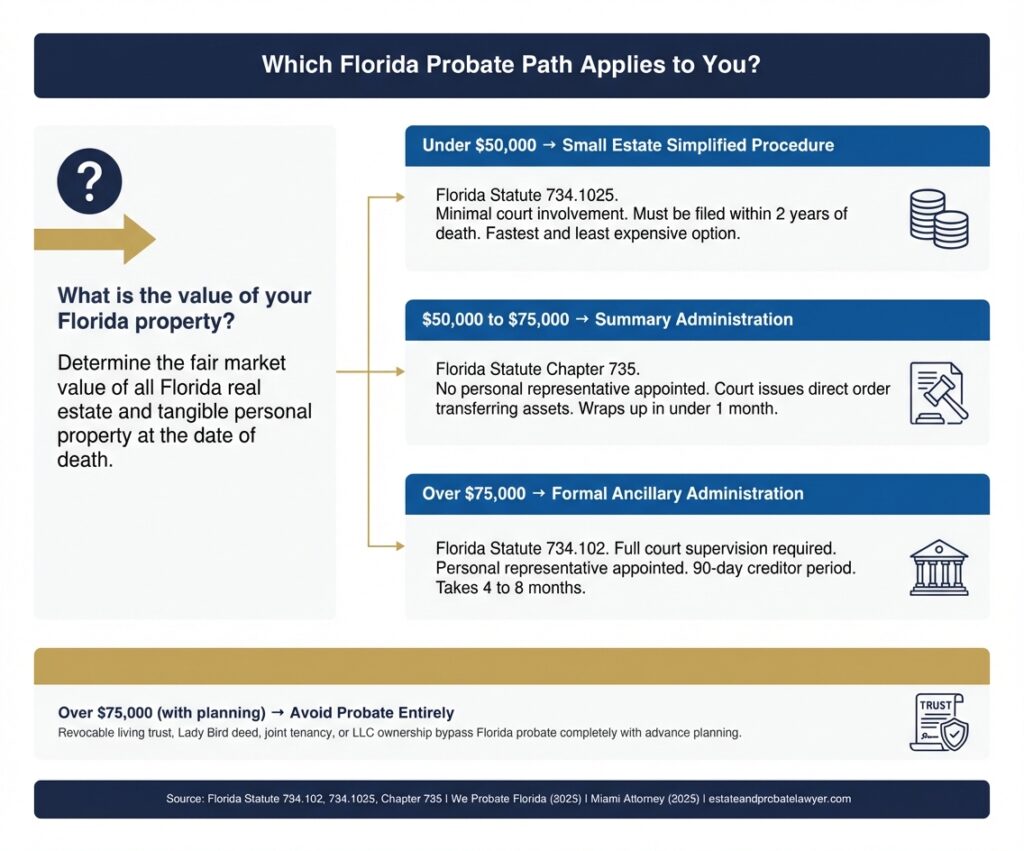
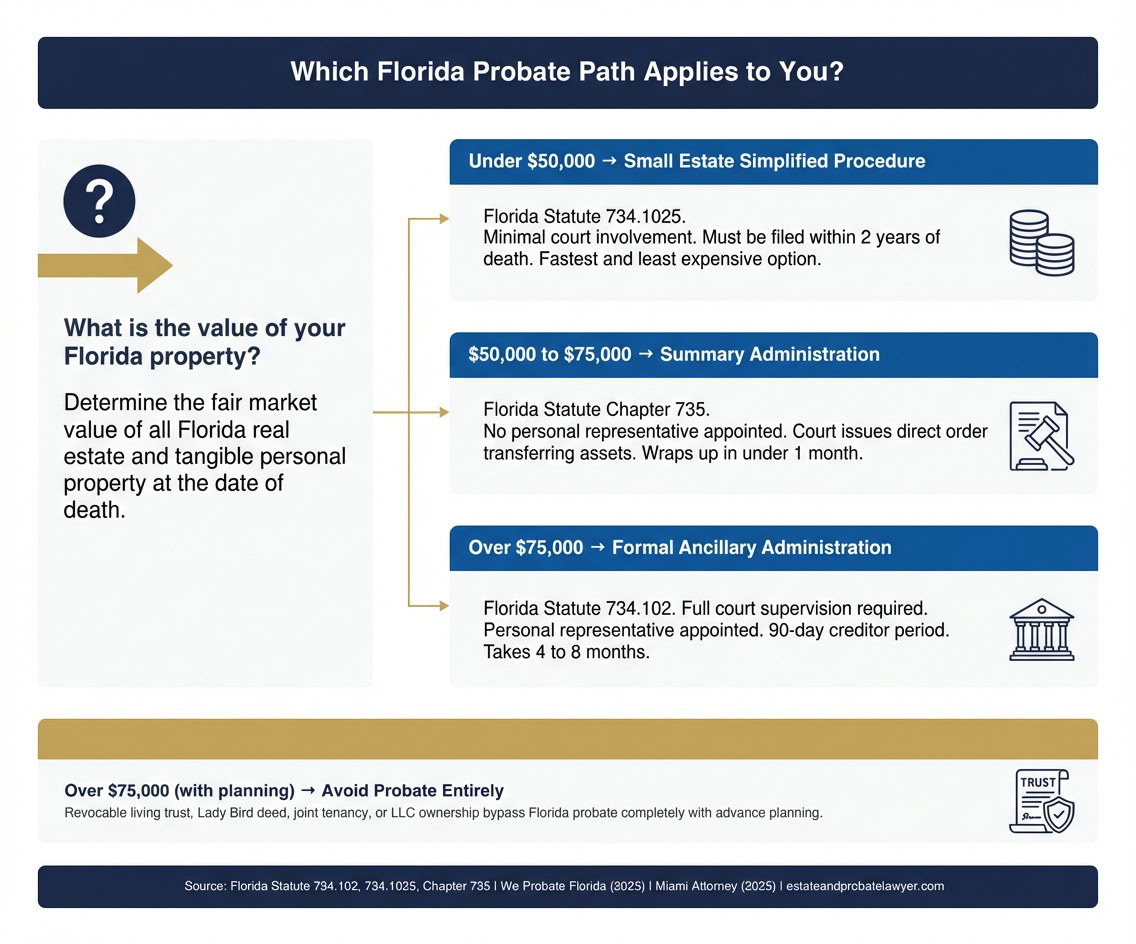
Under Florida Statute Chapter 735, summary administration is available when the value of Florida property falls below $75,000 (excluding exempt property). A separate simplified procedure under Florida Statute 734.1025 applies to small estates valued under $50,000 at the date of death.
Key differences between summary and formal administration:
- Summary administration wraps up in under 1 month
- No personal representative is appointed in summary administration
- The court issues an order of summary administration directly, transferring the property to beneficiaries
- Costs are lower because the process involves fewer court filings and no creditor notice period
The small estate simplified procedure under Florida Statute 734.1025 must be filed within 2 years of the decedent’s death. After 2 years, a foreign will is admitted to record without ancillary probate under Florida Statute 734.104.
What Is the $75,000 Threshold for Summary Administration?
The $75,000 limit applies to the value of Florida property only, not the total estate value across all states. “Value” means fair market value at the date of death.
Exempt property (such as household furnishings and certain personal items) is excluded from the $75,000 calculation. If your Florida property value sits close to the threshold, a professional appraisal confirms whether you qualify for the streamlined path.
The $50,000 small estate threshold under Florida Statute 734.1025 offers an even simpler option. According to We Probate Florida (2025) and Miami Attorney (2025), this simplified procedure requires minimal court involvement and is appropriate for timeshares, older vehicles, or small parcels of land.
 Which Florida Probate Path Applies to You?
How Can Out-of-State Owners Avoid Ancillary Probate in Florida?
Estate planning before death is the only reliable way to avoid ancillary probate. Once the property owner dies with Florida real estate titled in their name alone, ancillary probate becomes unavoidable.
Six strategies eliminate the need for ancillary probate entirely. Each has tradeoffs in cost, complexity, tax treatment, and asset protection. The right choice depends on the property type, the owner’s goals, and the family’s overall estate plan.
How Does a Revocable Living Trust Help You Skip Ancillary Probate?
Property titled in the name of a revocable living trust passes outside probate entirely. The successor trustee distributes trust assets according to the trust terms, with zero court involvement in Florida or any other state.
The trust must be properly “funded,” meaning the Florida property’s title must be transferred into the trust’s name. An unfunded trust (one where the property was never retitled) provides no probate avoidance.
Setup costs typically run $1,500 to $5,000, depending on the complexity of the trust agreement. Lorenzo Law (2025) and Trust & Will (2025) both identify revocable living trusts as the most reliable ancillary probate avoidance tool.
One important update: the Florida Uniform Fiduciary Income and Principal Act (FUFIPA) took effect January 1, 2025, replacing the previous Florida Uniform Principal and Income Act. FUFIPA changes how trustees allocate receipts and disbursements between income and principal, which affects trust administration rules for Florida property held in trust.
A revocable living trust is best suited for owners with multiple out-of-state properties or high-value Florida holdings where the cost of the trust is a fraction of the ancillary probate expense it prevents.
What Is a Lady Bird Deed and How Does It Avoid Ancillary Probate?
A Lady Bird deed (also called an enhanced life estate deed) allows the owner to retain full control of the property during life and automatically transfer the property to a named beneficiary at death. The property passes by operation of law, bypassing probate entirely.
The owner retains the right to sell, mortgage, or revoke the deed at any time, without the beneficiary’s consent. Florida is one of a small number of states recognizing Lady Bird deeds, making this tool especially useful for out-of-state owners of Florida property.
Key benefits of a Lady Bird deed, as outlined by Alper Law (2025):
- Retains homestead protections (if applicable to the property)
- Provides a stepped-up tax basis for beneficiaries at the owner’s death
- Creates no Medicaid clawback risk in Florida
- Costs far less than a trust (typically $500 to $1,500 to prepare and record)
The main drawback: Lady Bird deeds work best for a single known beneficiary or a small group of beneficiaries. For complex distributions involving multiple heirs, trusts provide greater flexibility.
Can an LLC Protect Florida Property from Ancillary Probate?
Yes. Transferring Florida real estate into an LLC converts the asset from real property (subject to ancillary probate) to a membership interest (personal property passing through domiciliary probate in the home state). Since the LLC is a legal entity, and the membership interest is personal property, no Florida probate is needed when the owner dies.
LLC formation and maintenance costs in Florida include:
- Florida filing fee: $125 for Articles of Organization
- Annual report: $138.75 per year
- Attorney setup: $500 to $2,000
Drawbacks to consider before choosing this route, per Aventus Law Group (2025):
- Loss of homestead exemption if the property qualifies as a primary or secondary residence
- Potential property tax reassessment by the county appraiser
- Ongoing compliance burden with annual reports, registered agent requirements, and operating agreement maintenance
- Mortgage complications from a potential due-on-sale clause if transferring a mortgaged property into the LLC
LLC ownership is best suited for rental and investment properties, not primary or vacation homes where homestead or insurance protections are at stake.
| Strategy | Estimated Cost | Complexity | Best For | Key Drawback |
| Revocable living trust | $1,500 to $5,000 | Moderate | Multiple properties, high-value holdings | Must fund the trust (retitle property) |
| Lady Bird deed | $500 to $1,500 | Low | Single property, simple beneficiary plan | Limited flexibility for complex distributions |
| Joint tenancy with survivorship | $200 to $500 | Low | Married couples, parent-child ownership | Loss of sole control during lifetime |
| LLC ownership | $625 to $2,000 + annual fees | Moderate | Rental and investment properties | Loss of homestead exemption, ongoing compliance |
| TOD/POD designations | Minimal | Low | Financial accounts, not real estate | Florida does not allow TOD deeds for real property |
Figure 8: Ancillary Probate Avoidance Strategy Comparison
Source: Trust & Will (2025), Aventus Law Group (2025), Lorenzo Law (2025)
Does Florida Recognize Out-of-State Wills for Ancillary Probate?
Yes. Florida recognizes wills validly executed under the laws of the state where the will was signed. Under Florida Statute 732.502, a will executed in compliance with the formalities of the signing state is accepted in Florida ancillary proceedings.
The will must be properly authenticated by the domiciliary court, not merely notarized. The authentication chain (apostille or court certification) confirms the will was admitted to probate in the home state and is a genuine court record.
One important distinction applies to holographic (handwritten) wills. Florida does not recognize holographic wills executed in Florida. But if the holographic will was validly executed in a state allowing them (such as Texas, California, or Virginia), Florida courts accept it for ancillary proceedings, per Beacon Legacy Law (2025).
The will must be admitted to probate in the decedent’s home state first. The authenticated copy then accompanies the ancillary petition filed in Florida. Without the domiciliary probate proceeding, the Florida court has no basis to accept the will.
If no will exists (an intestate situation), Florida intestacy laws (Lorenzo Law, 2025) govern the distribution of the Florida property. This adds complexity because Florida’s intestacy rules differ from those in many other states.
What Are the Tax Implications of Ancillary Probate in Florida?
Florida’s tax environment is favorable for estate transfers, but families must account for federal taxes and potential home-state obligations.
Florida state taxes: Florida has no state estate tax and no state inheritance tax. The state eliminated its estate tax effective January 1, 2005, after the federal “pick-up” credit was repealed. According to the Florida Department of Revenue (2025), no Florida estate tax is due for decedents dying on or after January 1, 2005. This makes Florida one of the most tax-friendly states for property transfers at death.
Federal estate tax: The federal estate tax applies only if the decedent’s total estate (across all states combined) exceeds the exemption threshold. Under the One Big Beautiful Bill Act (OBBBA), signed July 4, 2025 (Beacon Legacy Law, 2025), the exemption is now $15 million per person ($30 million per married couple) effective January 1, 2026. The federal estate tax rate remains 40% on amounts exceeding the exemption.
Florida property value counts toward the total federal estate calculation. A New York resident with a $10 million portfolio in New York and a $2 million vacation home in Florida has a $12 million total estate for federal purposes.
Stepped-up basis: Heirs receive a stepped-up cost basis on inherited property, equal to the fair market value at the date of death. This eliminates capital gains taxes on all appreciation during the decedent’s lifetime. Capital gains tax applies only on appreciation occurring after the date of death if the property is later sold.
Example: The decedent purchased a Florida condo for $200,000 in 2010. At death in 2026, the condo is worth $500,000. The heir’s new cost basis is $500,000. If the heir sells the condo for $520,000, the taxable capital gains amount is only $20,000 (not $320,000).
Home-state inheritance taxes: Six states impose inheritance taxes on their residents: Iowa, Kentucky, Maryland, Nebraska, New Jersey, and Pennsylvania. Residents of these states who inherit Florida property owe inheritance tax to their home state, even though Florida imposes no such tax. This cross-state interaction creates a planning consideration many families overlook.
Annual gift tax exclusion (2026): The current exclusion is $19,000 per recipient, per the Elder Law Center of Brevard (2025). Lifetime gifting strategies reduce estate size and minimize potential federal estate tax exposure for ultra-high-net-worth families.
How Does the 2026 Federal Estate Tax Exemption Affect Florida Property Owners?
The One Big Beautiful Bill Act permanently set the federal estate tax exemption at $15 million per person, effective January 1, 2026. This legislation eliminated the sunset clause from the 2017 Tax Cuts and Jobs Act, which had threatened to reduce the exemption to approximately $7 million per person at the end of 2025.
| Year | Exemption Amount (Individual) | Exemption Amount (Married Couple) | Source Law | Notes |
| 2024 | $13.61 million | $27.22 million | TCJA (2017) | Inflation-adjusted |
| 2025 | $13.99 million | $27.98 million | TCJA (2017) | Last year before OBBBA |
| 2026 | $15 million | $30 million | OBBBA (2025) | Permanent, inflation indexing begins 2027 |
Figure 9: Federal Estate Tax Exemption History (2024 to 2026)
Source: Beacon Legacy Law (2025), Elder Law Center of Brevard (2025), Nelson & Nelson (2025)
For the vast majority of out-of-state owners with Florida property, the federal estate tax will not apply. The $15 million per person threshold covers all but the wealthiest Americans.
For ultra-high-net-worth families, the combination of zero Florida estate tax and the elevated $15 million federal exemption creates a favorable environment for holding Florida real estate. Families below the threshold benefit from simplifying their estate plans. Families above the threshold should consider irrevocable trusts, family limited partnerships, and other tools to reduce their taxable estate.
What Are the Creditor Notice Requirements in Florida Ancillary Probate?
Creditor notification is a mandatory step in formal ancillary probate. The personal representative must publish a “Notice to Creditors” in a newspaper of general circulation in the county where the ancillary case is filed.
Publication requirements, per Florida Statute 733.702:
- The notice must run once per week for 2 consecutive weeks
- Unknown creditors have 3 months (90 days) from the date of first publication to file claims
- Known creditors must receive direct service (by mail or personal service) and have 30 days from the date of service to respond
After the creditor period closes, the personal representative pays valid claims from estate assets. The remaining property passes to beneficiaries. The personal representative reviews each claim, pays legitimate debts, and contests any invalid or inflated claims through the Florida court.
Failing to properly publish the creditor notice extends the creditor claim period and delays the entire proceeding. As DHC Law (2025) warns, a missed creditor notice is one of the most costly procedural errors in Florida probate. It reopens the claims window and pushes distributions back by months.
The personal representative also risks personal liability for distributions made before the creditor period closes. If a creditor files a valid late claim because notice was never properly given, the personal representative bears responsibility for the unpaid debt.
Can You Sell Florida Property During Ancillary Probate?
Yes, but only with court approval. The personal representative must petition the Florida court for authority to sell the property during the probate proceeding.
The process requires:
- A petition to the court requesting authorization to sell
- Fair market value support through a professional appraisal or comparable market analysis
- Notice to all interested parties, including beneficiaries and creditors
- Court order authorizing the sale before closing
The sale price must reflect fair market value. Florida courts scrutinize below-market sales to protect beneficiary interests. Title insurance companies require the court order before issuing a policy on the sale.
Proceeds from the sale replace the property in the estate. The personal representative distributes the funds to beneficiaries according to the will or intestacy law after paying all debts, taxes, and expenses.
Selling during probate is sometimes the best choice. Ongoing costs for property taxes, insurance, maintenance, and HOA or condo association fees continue accruing throughout probate. For a $500,000 property, annual carrying costs (taxes, insurance, HOA, and maintenance) run $8,000 to $15,000 or more. Selling early stops the financial bleed and converts the asset to liquid funds for distribution.
Source: Lorenzo Law (2025), Boatman Ricci (2025)
Frequently Asked Questions About Ancillary Probate in Florida
1. What is an ancillary probate petition in Florida?
An ancillary probate petition is a legal filing submitted to a Florida circuit court when a non-resident decedent owned real property or tangible personal property in Florida. Under Florida Statute 734.102, this petition opens a secondary probate proceeding to transfer title of the Florida assets. The petition must include authenticated documents from the domiciliary (home state) probate court.
2. How much does ancillary probate cost in Florida?
Straightforward ancillary probate cases cost $3,500 to $10,000 total. Court filing fees run $300 to $500, newspaper publication costs $150 to $300, and attorney fees follow the statutory schedule under Florida Statute 733.6171. Contested or complex cases with multiple properties or creditor disputes cost significantly more.
3. How long does ancillary probate take in Florida?
Summary administration wraps up in under 1 month. Formal ancillary administration for straightforward cases takes 4 to 8 months. Complex cases involving contested wills, creditor disputes, or title defects extend to 12 to 18 months. The mandatory 90-day creditor claim period sets the minimum timeline for formal proceedings.
4. How do you avoid ancillary probate in Florida?
The most effective strategies include placing Florida property in a revocable living trust, recording a Lady Bird deed (enhanced life estate deed), holding the property as joint tenants with right of survivorship, or transferring the property into an LLC. Each approach eliminates the need for Florida court involvement at death.
5. What documents are needed for an ancillary probate in Florida?
You need court-authenticated copies of the will, the petition for probate, the order admitting the will, and letters of administration from the home state. You also need two certified death certificates, a list of beneficiaries, an inventory of Florida property, copies of Florida deeds, copies of property tax bills, and a sworn statement accepting the personal representative role. “Authenticated” means bearing an apostille or formal court certification chain.
6. Does Florida allow out-of-state executors?
Yes, but with restrictions. Under Florida Statute 733.304, a non-resident executor must be related to the decedent by blood, adoption, marriage, or lineal descent. They must be at least 18, mentally competent, and free of felony convictions. Unrelated non-residents are disqualified and must be replaced by a Florida-resident personal representative.
7. Does Florida recognize out-of-state wills?
Yes. Florida accepts wills validly executed under the laws of the state where the will was signed, per Florida Statute 732.502. The will must be admitted to probate in the home state first, and the authenticated copy is then filed with the Florida ancillary petition. Holographic wills are accepted if valid in the originating state.
8. What property does not go through probate in Florida?
Property held in a revocable living trust, property owned as joint tenants with right of survivorship, property transferred through a Lady Bird deed, assets with payable-on-death or transfer-on-death designations, property held in an LLC, life insurance proceeds with named beneficiaries, and retirement accounts with named beneficiaries all bypass probate in Florida.
9. What is the difference between summary administration and formal ancillary probate in Florida?
Summary administration applies when Florida property value falls below $75,000. It takes under 1 month, no personal representative is appointed, and the court issues a direct order transferring assets. Formal ancillary probate is required when Florida property exceeds $75,000. It involves full court supervision, a personal representative appointment, a 90-day creditor period, and takes 4 to 8 months.
10. Does a Lady Bird Deed Avoid Ancillary Probate in Florida?
Yes. A Lady Bird deed (enhanced life estate deed) transfers Florida property automatically at the owner’s death, bypassing probate entirely. The owner retains full control during life, including the right to sell, mortgage, or revoke the deed. Florida recognizes Lady Bird deeds, and they provide added benefits: stepped-up tax basis for heirs, no Medicaid clawback risk, and retention of homestead protections.
Protecting Your Family Is a Phone Call Away
Ancillary probate adds time, expense, and complexity for families dealing with an out-of-state loved one’s Florida property. The right planning eliminates this burden entirely, and the right legal guidance makes the process manageable if ancillary probate becomes necessary.
The estate planning attorneys at SJF Law Group guide families through ancillary probate proceedings and help non-resident property owners structure their estates to avoid second-state probate altogether. When you work with our team, you receive clear guidance on filing requirements, personal representative qualifications, cost management, and avoidance strategies tailored to your situation.
Call us at 954-580-3690 or email info@estateandprobatelawyer.com today.